How to read the marks on a stoneware crock
What the big number means, where to find the maker's stamp, and how glaze and decoration narrow the date, with Red Wing as the worked example.
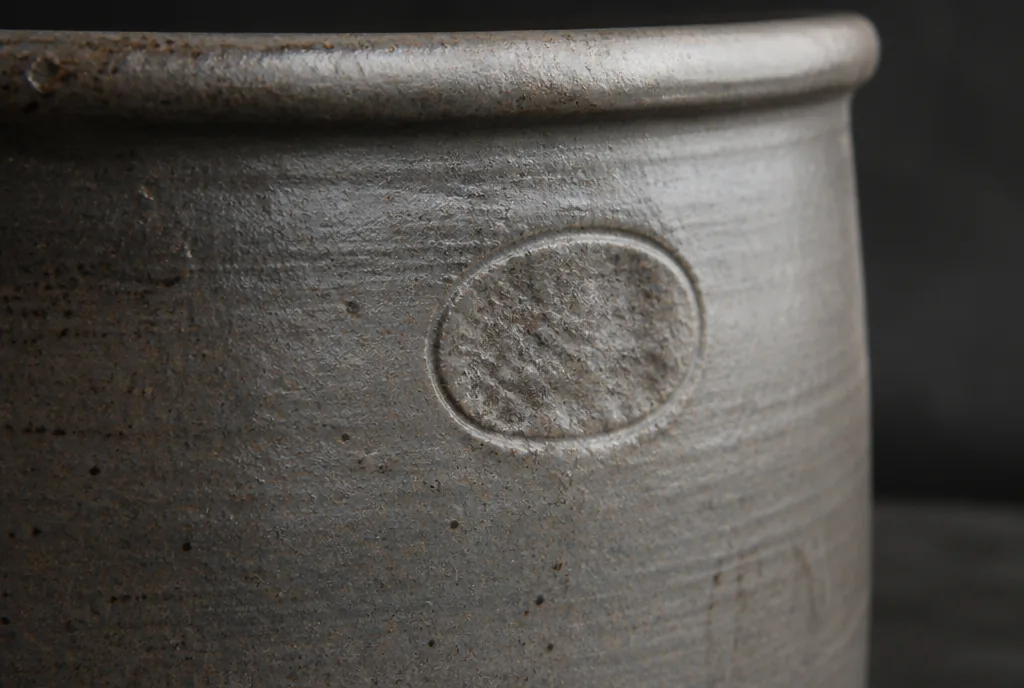
Quick answerThe large number on the front of a crock is its capacity in gallons, not a date or a pattern number. A maker’s mark, if there is one, went onto the raw clay before firing and usually sits near the top of the side wall or on the bottom. The glaze and the style of decoration help narrow the date, and many salt-glazed crocks were never marked at all.
This guide walks through what you can read off a crock: the size number, the maker’s stamp, the glaze and the decoration. The dated examples come from Red Wing, Minnesota, because that’s where the collector records are most detailed. They tell you what happened at one set of potteries. They don’t give you a timeline for every stoneware maker in the country.
First, make sure it’s stoneware
Stoneware is fired hot, roughly 1100 to 1200 C in the West, and comes out vitrified. That makes it far less absorbent than earthenware. Unlike porcelain, it isn’t translucent: hold a thin edge up to a strong light and nothing shows through.
Most American crocks you’ll meet are salt-glazed or white-glazed stoneware. Salt-glazed stoneware was the main household pottery in North America through the 19th century, and the earliest documented American production dates to the 1720s at Yorktown, Virginia.
The number on the front is the size
That bold 3, 5 or 10 on the side of the crock tells you how many gallons it holds. Sizes run from 1 gallon up to about 60. People often read it as a year or a catalog number. It’s neither.
On Red Wing pieces the capacity numeral sat on the side along with the decoration, and the company’s birch-leaf or red-wing stamp was placed alongside it. How the numeral was made can itself be a clue, which we come back to below.
Where the maker’s mark sits, and how it was put on
Look near the top of the side wall first, then turn the crock over and check the bottom. Maker marks went onto the raw clay before the piece was fired, so a genuine mark is part of the surface, not something added later.
Methods changed over time. Red Wing alone used ink stamps, impressed marks and hand-painted marks at different points in its history. A faint impressed name can disappear under glaze, so tilt the crock under a low, raking light and look for letters pressed into the clay.
Some crocks carry a cobalt inscription naming a maker, a merchant or a town. A merchant’s name tells you who sold the goods, which is not always the same as who made the crock.
One secondary guide, an app company’s blog, says impressed maker stamps are generally earlier than stenciled marks, with oil-paper stencils in use from about the 1860s. We haven’t found that rule in a collector society or auction-house reference, so treat it as a rough rule of thumb and not as a date.
Read the glaze
Salt glaze forms when salt is thrown into a hot kiln. The salt vaporizes, and the sodium bonds with silica in the clay. What you get is a thin, glossy surface with a slightly pebbled, orange-peel texture. At Red Wing, tan salt-glazed stoneware was made from 1877 for about 20 years.
Look inside as well. Large salt-glazed crocks were often sealed on the inside with a brown Albany slip so the contents wouldn’t seep into the clay.
The smooth, creamy white glaze came next. In the mid-1890s the Red Wing and Minnesota stoneware companies began replacing salt glaze with a white zinc glaze, the one collectors often call Bristol. Small white-glazed pieces were first sold in 1895, and by 1897 both firms were making large zinc-glazed pieces of 20 gallons and up. The white glaze was stronger, stained less and resisted acid pitting. It was also cheaper and faster to produce with less skilled labor, and it gave merchants a stark white ground for advertising.
Sources differ on when white glaze starts. The Red Wing Collectors Society gives the mid-1890s, with first sales in 1895, for Red Wing. Other secondary sources say “about 1896” or “c. 1900 onward.” Those dates also depend on the pottery, so a white glaze alone won’t date an unknown maker’s crock.
A white-glazed crock is not automatically from the 1900s. At Red Wing, white zinc glaze was on sale by 1895, and early transition pieces mix the new white glaze with the older hand-drawn cobalt decoration.
Read the decoration
Hand-drawn cobalt decoration such as leaves, butterflies and targets carried over onto early white-glazed transition pieces. Some of those still have Albany slip interiors, which makes them easy to spot once you know to look inside.
Stamped decoration is a different thing from hand-painting, and it’s easy to confuse the two. Stamped work is neater and repeats exactly from one crock to the next. Hand work wanders.
Red Wing’s early-1900s “elephant ear” leaf decoration shows how the two methods overlapped on a single design. On 2 to 6 gallon pieces the capacity numerals were ink-stamped, while on 8 gallons and up they were still drawn by hand. The elephant ears were gone before 1906.
Before 1909, Red Wing put a pair of rubber-stamped “birch leaves” on its utilitarian pieces. The red wing trademark stamp appeared around 1909 and replaced them.
We have no primary source for a general cobalt-decoration timeline outside Red Wing. For other potteries, check the maker’s own entry.
Red Wing date clues at a glance
| What you see | What it points to at Red Wing |
|---|---|
| Tan salt glaze, orange-peel surface | Made from 1877 for about 20 years; only around 20% was marked |
| Brown glaze on the inside of a salt-glazed crock | Albany slip, used to seal large crocks |
| Creamy white (zinc or “Bristol”) glaze, small piece | First sold in 1895 |
| White glaze on a crock of 20 gallons or more | Being made by 1897 |
| White glaze with hand-drawn cobalt leaves, butterflies or targets | Early transition piece; check for an Albany slip interior |
| “Elephant ear” leaves | Early 1900s; gone before 1906. Numerals stamped on 2-6 gallons, hand-drawn on 8 and up |
| Pair of rubber-stamped birch leaves | Before 1909 |
| Red wing trademark stamp | From around 1909, replacing the birch leaves |
If there’s no mark
An unmarked salt-glazed crock is normal. Only around 20% of Red Wing’s salt-glaze output carried a maker’s mark. Collectors attribute the rest by form, decoration, clay and glaze color, comparing the piece against documented examples.
Age shows up in the details too. Wear on the base, small glaze irregularities and kiln marks help separate old pieces from reproductions.
A crisp cobalt design that repeats exactly is stamped, not hand-painted. That doesn’t make it fake, but it does change which period it can belong to. Don’t call a piece hand-decorated until you’ve looked for wandering lines and uneven cobalt.
Putting it together
- Read the front number as gallons and set it aside.
- Check the top of the side wall and the bottom for a maker’s mark, using a raking light for impressed letters.
- Note the glaze outside (salt or white) and inside (Albany slip or not).
- Decide whether the decoration is hand-drawn or stamped.
- If you have a name, look it up in the Mark Finder or browse the stoneware makers. Red Wing pieces belong with Red Wing Union Stoneware or the Minnesota Stoneware Company.
- No name? Work through how to research an unmarked piece.
Sources
- Salt glaze pottery – Wikipedia
- Salt Glaze – Red Wing Collectors Society
- Zinc Glaze – Red Wing Collectors Society
- The Red Wing Union Stoneware Company – Red Wing Collectors Society
- Red Wing Pottery – Wikipedia
- Rare Antique Stoneware Crocks – Know Old Stuff
- The Salty Side of Stoneware – Antique Trader
- Antique Stoneware Crock Markings – Appraisily (secondary; app blog)
- Glossary: Stoneware – Gotheborg.com (Jan-Erik Nilsson)
Questions people ask
What is the brown glaze inside my crock?
On large salt-glazed crocks it is often Albany slip, a brown glaze used to seal the inside so the contents wouldn't seep into the clay. Some early white-glazed transition pieces at Red Wing also kept an Albany slip interior.
Why did potteries switch from salt glaze to white glaze?
The Red Wing Collectors Society says the white zinc glaze was stronger, stained less and resisted acid pitting. It was also cheaper and faster to make with less skilled labor, and it gave merchants a clean white ground for advertising.
How big do stoneware crocks get?
Sizes run from 1 gallon up to about 60 gallons. By 1897 Red Wing and Minnesota Stoneware were making white-glazed pieces of 20 gallons and up.
How can I tell an old crock from a reproduction?
Antique Trader points to wear on the base, small glaze irregularities and kiln marks as signs of an old piece. Compare those details with documented examples before drawing a conclusion.
The Mark Index is a reference for identifying and dating marks. It isn’t an appraisal or a guarantee of authenticity. Reproductions and later reissues can carry old marks.