Bottle Marks and Bottle Dating: A Field Guide
A glass bottle records how it was made: the seams, the lip, the base and the maker’s mark. This guide turns those features into a date range, with every date traced to the Society for Historical Archaeology’s bottle website, Bottle Research Group papers, the Federal Register, patents and trademark records.
No ads · No sign-up
Free to copy, print and adapt under CC BY 4.0: just credit The Mark Index. No advertising, no affiliate links, no email wall on the printable. We never put values on bottles.
Seams that run over the rim mean a machine-made bottle, so after about 1893 for jars and 1905 for narrow necks. Seams that stop below the lip mean mouth-blown, usually before about 1920.[1][2][4] A pontil scar on an everyday bottle points to before about 1870.[2][8][11] “Federal Law Forbids Sale or Re-use of This Bottle” dates a liquor bottle to 1935 through 1964.[3][21][22][23][24] A maker’s mark, read with its date code, often narrows it to the year.
Start with the SHA bottle site, then come back
The standard reference is the Historic Glass Bottle Identification & Information Website, built by Bill Lindsey for the Bureau of Land Management and the Society for Historical Archaeology. It moved: the old sha.org/bottle/ and blm.gov/historic_bottles/ addresses no longer work. It now lives at secure-sha.org/bottle/, with its dating key at secure-sha.org/bottle/dating.htm and the Bottle Research Group’s maker’s-mark encyclopedia at secure-sha.org/bottle/makersmarks.htm.
This page doesn’t replace it. It’s a companion for the bench and the classroom: one interactive tool, a one-page flowchart, and a maker table that pulls together the Bottle Research Group’s revised dates. Every clue links to the papers behind it, most of them on the SHA site.
Updating a research guide? Swap sha.org/bottle/ for secure-sha.org/bottle/; the page names are the same.
Three rules before you date anything
- Expect a range, not a year. From manufacturing features alone, most utilitarian bottles can only be placed within about 10 to 15 years.[85][86]
- Floors are firmer than ceilings. A technique can’t predate its invention, but once developed it can be used right up to the present. Treat end dates with care.[85][86]
- The bottle dates the bottle. Bottles were refilled and reused for years, especially soda, beer and milk bottles. A bottle’s date isn’t the date of the layer it came from.[24][85]
These dates are for American-made utilitarian bottles and jars: medicine, food, soda, beer, milk, liquor, ink and household. Perfume, barber, decanter and other specialty bottles often follow older methods.[85][86]
Narrow the date
Tap every feature you can see. Groups marked “pick one” take a single answer. The tool combines the ranges and shows which clue sets each limit. Only clues with at least two independent sources are included.
The one-page dating flowchart
The same logic as the tool, for paper. Print it for a lab bench, a field kit or a classroom.
Yes: machine-made
- Feathered, off-center circle (suction scar): Owens machine, about 1905 to about 1950
- Small round scar dead center (valve mark): press-and-blow, mostly 1900s to 1940s
- Stippled dots: 1940 or later
- FEDERAL LAW FORBIDS SALE OR RE-USE: 1935 to 1964
- Script Duraglas: 1940 to about 1964
- NO DEPOSIT NO RETURN: 1939 on
- Painted, baked-on label: 1933 on
No: mouth-blown
- Yes: before about 1870 (iron residue: about 1845 to mid-1860s)
- No, smooth base: about 1850 on, usually after 1855 to 1865
- Cracked off or sheared: before about 1870
- Applied collar, ridge inside the mouth: about 1820 to 1890
- Tooled, seams wiped below it: about 1885 to 1920
- Seam runs into the tooled lip: about 1895 to early 1920s
- Fine rings, glossy (turn-mold): about 1880 to 1915
- Lopsided free-blown or dip-molded: before about 1870
- Pale purple tint: about 1875 to 1920
- Crown-cap lip: about 1894 on
- Hutchinson stopper: 1879 to mid-1910s
Attribution line: “Bottle Marks and Bottle Dating: A Field Guide” by The Mark Index (https://themarkindex.com/bottle-marks-and-bottle-dating/), licensed under CC BY 4.0.
Dating features at a glance
“About” marks a soft limit. The superscript numbers lead to the sources; “Details” leads to the explanation below.
| Feature | Date range | What it tells you | Sources |
|---|---|---|---|
| How it was made | |||
| Mouth-blown: side seams fade out below the lip | before about 1920 (most U.S. molded mouth-blown bottles about 1820 to 1915); small-run specialty types into the 1930s | Hand-finished. Most U.S. molded mouth-blown bottles date about 1820 to 1915. | Details [1][2][4] |
| Machine-made, wide mouth (jar, food or milk bottle) | about 1893-1894 onward; common from about 1900-1905 | Semi-automatic press-and-blow machines made wide-mouth ware from the mid-1890s. | Details [2][3][4] |
| Machine-made, narrow neck | about 1905 onward (Owens); non-Owens U.S. narrow-neck machine bottles mostly after 1908-1910 | U.S. narrow-neck machine bottles start with Owens production in 1905; most are after about 1910. | Details [1][2][3][5] |
| Seams and molds | |||
| Side seams run over the rim (rim not ground) | after about 1900 for wide-mouth, after about 1910 for narrow-neck (rare from mid-1890s) | A machine trait: after about 1900 for wide mouths, after about 1910 for narrow necks. | Details [1][2] |
| Horizontal seam just below the lip | mid-1890s onward (wide mouth); 1905 onward (narrow neck) | With other machine traits, a sign of machine manufacture. | Details [1][2][3] |
| No seams, lopsided (free-blown) | before about 1870 for U.S. utilitarian bottles | U.S. utilitarian bottles were rarely free-blown after the 1860s. | Details [8][14] |
| Body molded, no side seams, shoulder free-formed (dip mold) | 18th century to about 1865-1870 (U.S. maybe early 1870s) | Largely gone by about 1865 to 1870. | Details [2][14] |
| No seams, fine horizontal rings, glossy (turn-mold) | mostly about 1880 to 1915 (U.S.); imported examples from the 1860s, a few to the early 1920s | Most date about 1880 to 1915. | Details [2][14] |
| Seam around the shoulder plus seams up the neck (three-piece mold) | 1821 to the 1910s-1920s (liquor use mostly 1821-1840s; later pharmaceuticals, inks) | Ricketts patented the mold in 1821; used into the 1910s and 1920s. | Details [2][8][14] |
| Seam straight across the base, no pontil (hinge mold) | mostly about 1855 to the early-mid 1870s (true two-piece molds in use from about 1750 to about 1880) | Mostly about 1855 to the early 1870s. | Details [2][8][11] |
| Tiny raised dots in the embossing or on the shoulder (air vents) | mouth-blown: from the early-mid 1880s, standard by about 1890; rare before 1880 | Rare before 1880 on mouth-blown bottles; standard by about 1890. | Details [2][14] |
| Lettering inside a sunken or framed panel (plate mold) | late 1840s onward (body plates common from the late 1860s); used on mouth-blown bottles to the 1910s and on machine bottles after | From the late 1840s on sodas; common on druggist bottles from 1867 to 1868. | Details [2][14] |
| Lip (finish) | |||
| Cracked-off or sheared lip, no added glass | before about 1870 (most U.S. examples 1860s or earlier) | U.S. bottles with this lip rarely date after the 1860s. | Details [7][8] |
| Applied lip: a separate collar, with a ridge inside the mouth | about 1820 to 1890 (large beer/liquor bottles to about 1895) | Typically about 1820 to 1890. | Details [7][8][11] |
| Tooled lip: shaped from the neck glass, seams wiped out below it | dominant about 1885-1890 to 1910-1920 (some druggist bottles from the 1870s) | Mostly about 1885 to 1920. | Details [2][7][9] |
| Seam runs up into the tooled lip but not over the rim | about 1895 to the early 1920s (most 1900-1920) | About 1895 to the early 1920s. | Details [7][9] |
| Ground, frosted rim (mostly fruit jars) | about the 1850s to about 1920 (wide-mouth jars mostly gone by the early 1900s; narrow-mouth to the 1920s) | About the 1850s to about 1920. A mouth-blown trait. | Details [1][2][7][8] |
| Base | |||
| Pontil scar of any kind | before about 1870 (most before 1860-1865) | On utilitarian bottles, virtually always before about 1870. | Details [2][8][11] |
| Iron pontil: red or black iron residue | mostly about 1845 to the mid-1860s (as early as the 1830s, as late as about 1870) | Mostly about 1845 to the mid-1860s. | Details [8][12] |
| Smooth base on a mouth-blown bottle | about 1850 onward (95%+ of utilitarian examples after 1865) | The snap case replaced the pontil rod from about 1850. | Details [2][8][11] |
| Feathered, often off-center circle (Owens suction scar) | 1904-1905 onward, usually after 1910; Owens machines phased out by about the late 1940s-early 1950s | Owens machine: 1904 to 1905 onward, out of use by about 1950. | Details [2][3] |
| Small round scar centered on the base (valve mark) | mid-1890s onward on wide-mouth ware; most common early 1900s to 1940s | Press-and-blow machine; mid-1890s onward on wide-mouth ware. | Details [2][3] |
| No seam on the base, seam at the heel (cup-bottom mold) | about 1850 to present (mouth-blown mostly mid-1880s to late 1910s) | About 1850 to the present. Dates loosely on its own. | Details [2][11] |
| Stippled base or heel: a field of tiny raised dots | 1940 onward | Owens-Illinois began stippling in 1940; others followed. | Details [3][10] |
| Closure | |||
| Crown-cap lip | 1892 patent; in practice about 1894-1895 onward; universal on carbonated drinks by about 1912-1920 | Painter’s crown patent, 1892; in practice about 1894 on. | Details [2][4][8][13][17] |
| Hutchinson soda (internal wire-loop stopper) | 1879 patent; most common mid-1880s to about 1905; effectively ended mid-1910s | 1879 patent; effectively ended in the mid-1910s. | Details [2][13][18] |
| Wire-bail lever stopper (Lightning type) | invented 1870s (basic patent 1875); Putnam jar patent 1882; peak beverage use 1880s to late 1920s; still made | Patented in the 1870s and still made. Only a floor. | Details [2][8][13][19] |
| MASON’S PATENT NOV 30TH 1858 on a jar | 1858 or later; most such jars made decades later (1870s-1910s and machine-made after 1900) | A patent date, not a making date. Most such jars are decades later. | Details [2][13][20] |
| Glass color | |||
| Clear glass turned pale purple (sun-colored amethyst) | about 1875-1880 to about 1920 (outliers 1820s-1930s) | Manganese decolorizer: about 1875 to 1920. | Details [2][8][15][16] |
| Clear glass with a straw tint in thick spots | about 1912-1915 to the 1950s (in use by 1910, popular about 1917) | Selenium decolorizer: about 1912 to 1915 into the 1950s. | Details [15][16] |
| Colorless (clear) | uncommon before the 1870s; common from about 1880-1890; dominant after the mid-to-late 1910s | Uncommon on bottles before the 1870s. | Details [8][15][16] |
| Black glass (very dark olive or amber) | before about 1880-1885 for U.S.-made bottles (imports into the 1890s) | U.S.-made black glass was uncommon after about 1880. | Details [8][16] |
| Words and labels | |||
| FEDERAL LAW FORBIDS SALE OR RE-USE OF THIS BOTTLE | required from 1935 (in force by January 1, 1935) until December 1, 1964; some molds used the wording for years after | Required on liquor bottles from 1935 to December 1, 1964. | Details [3][21][22][23][24] |
| Painted, baked-on label (ACL) | 1933 onward (experiments 1931; soda bottles about 1934); widely accepted by the early 1940s; still used | Commercial applied color labels began in 1933. | Details [2][3][25] |
| Duraglas in script | 1940 to about 1964 (occasionally to about 1970) | Owens-Illinois, 1940 to about 1964. | Details [3][10][26][27] |
| NO DEPOSIT NO RETURN / NOT TO BE REFILLED | 1939 onward (industry standard wording from 1941) | Single-trip beer bottles, 1939 onward. | Details [28][29] |

Step by step
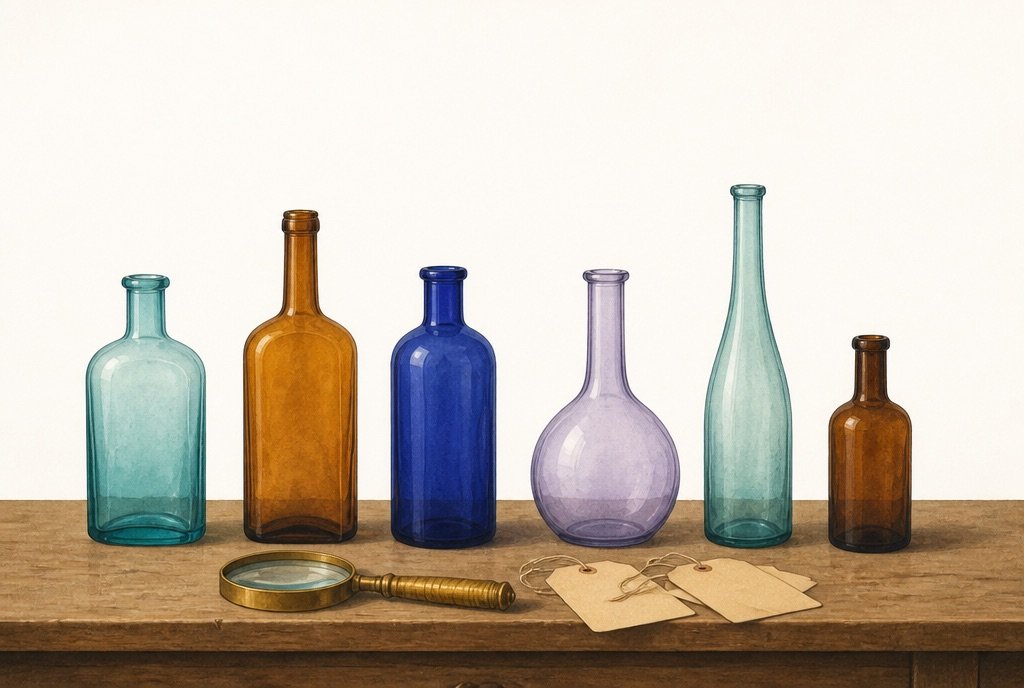
Work through the bottle in this order: how it was made, the base, the lip, the mold, the color, the closure, then any words and marks. Each step can only narrow what the step before it found. The wine bottle shown here is free-blown, with no mold seams at all, and is the sort of early bottle the pontil and finish steps are built for.
Step 1: Mouth-blown or machine-made?
Start at the neck. On a machine-made bottle the vertical side seams run all the way up the lip and over the top of the rim, and a horizontal seam usually circles the neck just under the lip.[1][2][3] On a mouth-blown bottle the side seams fade out on the neck or just below the lip, because the lip was formed or finished by hand.[1][2][4]
The split is the single most useful date line in American bottle glass. Most U.S. molded mouth-blown bottles were made between about 1820 and 1915, and by 1917 hand-blown containers were only about 5 to 10 percent of U.S. production.[1][2][4] Semi-automatic press-and-blow machines were making wide-mouth jars and food bottles from the mid-1890s (sources differ between 1893 and 1894).[2][3][4] Narrow-neck bottles followed with the Owens Automatic Bottle Machine.[1][2][3][5]
A note on that machine’s date. Michael Owens filed the patent on April 13, 1903, and it issued as U.S. Patent 766,768 on August 2, 1904. Some bottles were made on it from October 1904; serious commercial production began in 1905.[3][4][5][6] The familiar “patented 1903” is the filing year.
Two exceptions. Ground-rim fruit jars and flasks have seams that reach the rim but are mouth-blown: the rough top was ground off after blowing.[1][2][7][8] And some early machine-made milk and ink bottles have seams that stop short of the rim.[1][2]
Seam height on a mouth-blown bottle is not a date. A 1963 collector’s chart read the side seam like a thermometer: the higher it ran, the newer the bottle. Bottle Research Group authors tested it against securely dated bottles and found that seam height depended on the tools and the workman, not the decade.[1][9] Only a seam that goes over the rim is diagnostic.
Step 2: Machine marks on the base
Turn a machine-made bottle over. A suction scar, a thin, feathered circle that is often off-center and can run up onto the heel, comes from an Owens-type machine, which sucked glass up into the mold. It can’t predate 1904 (in practice 1905) and is usually after 1910. Owens machines were replaced by gob-fed machines from the 1920s and went out of production around the late 1940s or early 1950s.[2][3]
A small, neat valve mark centered on the base comes from a press-and-blow machine. It turns up mostly on wide-mouth jars, food and milk bottles, most often from the early 1900s through the 1940s. On a narrow-neck soda or beer bottle it points to the early 1910s.[2][3]
Stippling, a field of tiny raised dots on the base or heel, was introduced by Owens-Illinois in 1940 along with its Duraglas glass and was soon copied across the industry. A stippled bottle dates from 1940 or later. A plain base doesn’t prove an earlier date.[3][10]
A cup-bottom mold leaves no seam on the base and a seam just above the heel. It was used from about 1850 to the present and is the usual machine mold, so it dates loosely on its own.[2][11] A round or oval seam inside the base marks a post-bottom mold. Bill Lindsey dates mouth-blown post-bottom bottles from the mid-to-late 1850s to about 1890; we found no second source for that range, so it isn’t in the tool.[2][11]
Step 3: Pontil scars and smooth bases
A pontil scar is the rough spot left where a rod held the bottle while the lip was finished. On American utilitarian bottles (medicine, food, soda, liquor, ink) it usually means manufacture before or during the Civil War and virtually always before the early 1870s.[2][8][11] By 1870 no more than about 5 percent of utilitarian bottles were pontiled, according to an estimate quoted on the SHA site.[2][8][11]
The types overlap. A bare iron (“improved”) pontil leaves a reddish or black residue and mostly dates from about 1845 to the mid-1860s.[8][12] Sand pontils and blowpipe or glass-tipped pontils fall under the same general ceiling; the SHA site gives narrower dates for each, but we found only that one source for them.[12]
A smooth base on a mouth-blown bottle means it was held in a snap case, a tool that gripped the body and left no scar. Snap cases were coming in from the late 1840s, so a smooth-based mouth-blown utilitarian bottle usually dates after about 1855 to 1865.[2][8][11]
Perfume, barber and other “specialty” bottles, demijohns and many imports kept pontils much longer. Use pontil dates for everyday containers only.[2][8][11]
Step 4: The lip (finish)
Glass people call the lip the finish. On mouth-blown bottles its construction narrows the date fast.
- Cracked-off or sheared
- The bottle was simply broken or cut from the blowpipe and left rough or fire-polished. American bottles with this lip rarely date after the 1860s. (Newman’s 1970 dating key ends it about 1840; the SHA site puts the practical end at about 1870.)[7][8]
- Applied
- A separate gob of glass was added to the neck and shaped. Look inside the mouth for a ridge or seam where the added glass meets the neck. True applied finishes typically date about 1820 to 1890; small druggist bottles switched to tooled lips by the late 1870s, big beer bottles by about 1895.[7][8][11]
- Tooled
- The lip was formed from the neck’s own glass with a finishing tool, which also wiped out the side seams for up to an inch below it. Most tooled-lip bottles date from about 1885 to 1890 into the 1910s, and hand tooling largely disappeared between 1910 and the early 1920s.[2][7][9]
Concentric tooling marks on the lip show hand finishing but date loosely: lipping tools were in use from the late 1820s until mouth-blown production ended in the mid-1920s.[2][13]
Step 5: Molds, seams and embossing panels
If you find no side seams at all, the bottle was free-blown, dip-molded or turned in a paste mold.
- Free-blown bottles are often lopsided with soft, flowing lines. U.S. utilitarian bottles were rarely made this way after the 1860s.[8][14]
- Dip-molded bottles have a molded body and a hand-formed shoulder and neck. The method had largely disappeared by about 1865 to 1870.[2][14]
- Turn-mold (paste-mold) bottles were spun in a wet mold, which erased the seams and left fine horizontal rings and a glossy surface. Most date from about 1880 to 1915.[2][14]
Among seamed mouth-blown bottles, a three-piece mold leaves a seam around the shoulder plus seams up the neck. Henry Ricketts patented his version in England in 1821, and such molds were used into the 1910s and 1920s.[2][8][14] A hinge mold seam that runs straight across the base (with no pontil scar) mostly dates from about 1855 to the early 1870s.[2][8][11]
Air-venting marks, tiny raised dots on the shoulder, body or in the lettering, were rare before 1880, common by the mid-1880s and standard by about 1890. Machine molds have them too.[2][14]
Plate molds let a glassworks drop a customer’s lettered plate into a stock mold, which is why so much embossing sits inside a sunken or framed panel. The SHA site documents plate-molded sodas from the late 1840s; the Parks Canada glossary starts body plates with an 1867 U.S. patent and Whitall Tatum’s 1868 catalog.[2][14]
Step 6: Glass color
Color helps, but only as a supporting clue.
- Sun-colored amethyst. Manganese was added to make glass colorless; ultraviolet light then turns it pink to purple. Popular use began by the mid-1870s and the practical end for most bottles is about 1920.[2][8][15][16] The usual story, that World War I cut off German manganese, is incomplete: Lockhart and the SHA site both say the bigger reason was the tank furnaces of the new bottle machines, where manganese worked poorly.[2][8][15][16] Bottles irradiated on purpose can be a deep purple, so color alone doesn’t prove age.
- Straw tint. Colorless glass decolorized with selenium (often with arsenic) shows a faint straw or amber cast in its thick parts. It’s typical of machine-made bottles from about 1912 to 1915 into the 1950s.[15][16]
- Colorless bottles were uncommon before the 1870s and became the dominant bottle color once automatic machines spread in the mid-to-late 1910s.[8][15][16]
- Black glass, so dark an olive or amber that it looks black, was mass-produced for liquor and ale bottles from the 1840s to the 1880s; American-made examples were uncommon after about 1880.[8][16]
- Aqua and amber date poorly. The SHA site notes that aqua became uncommon after the 1920s except on sodas and some fruit jars, and that “old” off-shade ambers are rare after 1890; we found no second source for either, so neither is in the tool.[15][16]
Step 7: Closures and patent dates
Crown-cap lips follow William Painter’s crown cork, patented February 2, 1892. Virtually all crown-finish bottles date after about 1894 to 1895; mouth-blown crown bottles run to about 1914 to 1915, and later ones are machine-made.[2][4][8][13][17]
The Hutchinson stopper, an internal rubber gasket on a wire loop, was patented by Charles Hutchinson on April 8, 1879. It was probably the most common U.S. soda closure from the mid-1880s to about 1905 and effectively ended in the mid-1910s.[2][13][18]
Lightning-type wire-bail stoppers were patented in the 1870s, and Henry Putnam’s jar version on April 25, 1882. They are still made, so they only set a floor.[2][8][13][19]
Patent dates are floors. “MASON’S PATENT NOV 30TH 1858” appears on fruit jars made for decades after John Mason’s patents expired, including machine-made jars. Any embossed patent date only says “no earlier than,” and it may refer to the closure rather than the bottle.[2][8][13][20]
External screw threads for metal caps were standardized across the industry between 1919 and 1924, according to the SHA site; we found no second source for that range.[13]
Step 8: Words, labels and date codes
1935 to 1964, not 1933. This wording is often dated from the end of Prohibition in December 1933. The record says otherwise. It was a Treasury regulation issued under the Liquor Taxing Act of June 18, 1934, in force from January 1, 1935.[3][21][22][23][24] Treasury Decision 6762, published in the Federal Register on October 17, 1964, deleted the requirement, effective December 1, 1964.[3][21][22][23][24] Old molds kept the wording on some bottles made after that, so treat 1964 as a soft ceiling. The regulation spells it “Reuse”; bottles usually read RE-USE.
Applied color labels (ACL), baked-on enamel lettering, began commercially in 1933: Brockway offered them that February, and Owens-Illinois had experimented from 1931. Parks Canada gives 1934. They’re still used, so ACL is only a floor.[2][3][25]
Duraglas in script on an Owens-Illinois bottle dates from 1940 (the trademark’s claimed first use is September 4, 1940) to about 1964, occasionally to about 1970 on old molds.[3][10][26][27] The SHA site says block-capital DURAGLAS was embossed after 1963; Lockhart and Hoenig say the block-letter name belonged to a coating and was never embossed.[3][10][26][27]
NO DEPOSIT NO RETURN / NOT TO BE REFILLED on a beer bottle dates from 1939, when the single-trip bottle was announced, and became industry-standard wording in 1941. Earlier one-trip beer bottles without the words go back to 1935.[28][29]
Reading an Owens-Illinois date code
On an Owens-Illinois base, the number to the right of the mark is usually the year and the number to the left is the plant. Early codes are a single digit that repeats each decade, so a 0 can mean 1930 or 1940. Pick the decade with other clues: script Duraglas or stippling means 1940 or later, and two-digit codes spread from about 1943 to 1946. Code practice varied by bottle type and plant, and liquor bottles followed federal permit rules, so treat any single reading with care.[3][10]
Maker’s marks on American bottles: the major makers
Marks are described in words; we don’t reproduce them. Years come from the Bottle Research Group’s Encyclopedia of Manufacturer’s Marks on Glass Containers, checked against USPTO trademark records and a second published source. Where the Bottle Research Group revised Julian Toulouse’s 1971 Bottle Makers and Their Marks, the revised date is shown.
| Maker | Marks, in words, and years used | Dating tip | Sources |
|---|---|---|---|
| Owens-Illinois Glass Co.Toledo, Ohio |
| Read the digit to the right of the mark as the year, then decide the decade: Duraglas script or a stippled base means 1940 or later, so a lone "1" with Duraglas is 1941, not 1931. Revised date No clean 1954 cutoff: the diamond version shows up on bottles date-coded into 1966. | [3][10][30][31][32][33] |
| Owens Bottle Co.Toledo, Ohio |
| A Square-O with a single digit to its right is a 1920s bottle: read the digit as 192x. Look for the Owens suction scar on the base as confirmation. Revised date Started April 1919, not 1911 as Toulouse had it. | [34][35] |
| Illinois Glass Co.Alton, Illinois |
| Diamond-I bottles are machine-made (look for an Owens suction scar) and date 1915-1929; a diamond with an O wrapped around the I is Owens-Illinois, 1929 or later. Revised date Diamond-I trademark claim is June 1, 1915, not 1916. | [36][37][38][39] |
| Anchor HockingLancaster, Ohio |
| An anchor-H base cannot predate mid-1938, even though the company formed at the end of 1937; read the right-hand number as the year. Revised date Anchor-H first use was June 11, 1938, not the 1937 merger year. | [40][41][42][43][44] |
| Hazel-Atlas Glass Co.Wheeling, West Virginia (origins in Washington, Pennsylvania) |
| Do not look for a year code: Hazel-Atlas did not use date codes before the 1956 sale to Continental Can, so an H-over-A jar dates only to 1923-ca.1964 unless a label or style narrows it. Revised date Trademark claims use from July 1923, not 1920. No date codes before 1956. | [45][46] |
| Brockway Glass Co.Brockway, Pennsylvania |
| On a Circle-B base, a B with serifs suggests before ca. 1964; a plain sans-serif B suggests ca. 1964 or later. Check the date code to the right. Revised date The circled B dates from 1933; Toulouse’s 1925 belongs to a plain B. | [47][48][49] |
| Ball BrothersMuncie, Indiana (Buffalo, New York 1884-1886) |
| On Ball jars, check three things in order: is the a dropped (pre-1923), is there an underline (absent 1923-1933), and is there a curl inside the B (gone after ca. 1960). | [50][51][52] |
| Kerr Glass Mfg. Co.Portland, Oregon |
| Kerr packer jars with AHK usually lack date codes; an AHK beverage bottle will normally carry a date code, and those start around 1969-1972. | [53][54][55] |
| Knox Glass Bottle Co.Knox, Pennsylvania |
| A keystone with a letter other than K usually means a Knox branch plant before ca. 1952; a K keystone could be any Knox plant up to 1968. Revised date From 1932 (trademark date), not Toulouse’s 1924. | [39][56] |
| Glass Containers, Inc.Vernon, California (later Fullerton and Hayward, California) |
| West Coast soda and food bottles of the 1930s-60s with the angular GC are Glass Containers; the rounded GC means 1967 or later. Revised date Angular GC from 1933 to 1934, not 1945. | [57][58][59] |
| Thatcher Glass Mfg. Co.Elmira, New York (origins Potsdam, New York |
| Thatcher began date codes in late 1909, earlier than most makers, so most Thatcher milk bottles can be dated to the year from the base. Revised date Block MTC from 1923 and serif MTC from 1944, not “1900 to date.” | [60][61][62] |
| Liberty Glass Co.Sapulpa, Oklahoma |
| The three Liberty marks overlap for decades; trust the date code on the base, not the punctuation. Revised date L-G from 1936; Toulouse’s 1946 is probably a typo. | [39][63][64] |
| Diamond Glass Co.Royersford, Pennsylvania |
| An empty diamond with no letter inside, on a soda, beer or packer bottle, points to Diamond Glass of Royersford; a diamond with an I inside is Illinois Glass. Revised date In use by 1889, probably from 1887, not 1924. | [65][66] |
| Armstrong Cork Co.Lancaster, Pennsylvania (glass plants Millville, New Jersey and Dunkirk, Indiana) |
| Read the two-digit number near the Circle-A as the year (e.g. 47 = 1947); an underline beneath the circle means the Dunkirk, Indiana plant. | [67][68][69] |
| Chattanooga Glass Co.Chattanooga, Tennessee |
| On a hobble-skirt Coke bottle, a Circle-C on the skirt or base means Chattanooga Glass; the number beside it is usually a date code. | [70][71][72] |
| LatchfordLos Angeles / Huntington Park, California |
| Western bottles: Circle-LM means 1939-1957; Circle-L with a stippled base is most likely the post-1957 firm. | [39][73] |
| Maywood Glass Co.Los Angeles area (Maywood / Compton), California |
| On an MG-ligature base, a squared G points to 1944 or later; a rounded G to the earlier years. | [74][75][76] |
| Federal Glass Co.Columbus, Ohio |
| A Shield-F on a jelly tumbler or mug is Federal; on a container it is probably not, since the trademark excluded bottles and jars. | [77][78] |
| Whitall TatumMillville, New Jersey (offices Philadelphia and New York) |
| Druggist bottles: W.T.&Co. = before 1901, W.T.Co. = 1901-1920s; the triangle mark means machine-made, 1920s-1940s. | [79][80][81] |
| WheatonMillville, New Jersey |
| Small vials and lab bottles with a Circle-W date from 1946 on; if "WHEATON" or "WHEATON, N.J." accompanies it, think 1970 or later. | [81][82] |
| Obear-Nester Glass Co.East St. Louis, Illinois |
| A Box-N base (common on amber Purex and Orange Crush bottles) is Obear-Nester, 1915-1978; use the date code where present. | [76][83][84] |
Look-alikes are common. A letter in a circle, diamond or keystone was used by several unrelated companies, and Wheaton and others made decorative reproduction bottles in the 1960s to 1980s. Confirm a mark with the full Bottle Research Group chapter before you date by it.[39][56][81][82]
For archaeologists and registrars
- Record the features, not just the date
- Write down seam position, lip construction, base marks, color and any embossing exactly as seen. A later researcher can re-date a well-described bottle; a bare “ca. 1900” can’t be checked.
- Fragments still count
- A finish, a base with a pontil or suction scar, or a heel with part of a maker’s mark carries most of the dating information. Bases and lips are worth bagging separately.

For educators, archaeologists and librarians
This guide is licensed CC BY 4.0. Link to it, print the flowchart, put it in a lab manual, a field school packet or a research guide; just credit The Mark Index. There are no ads and nothing to sign up for. Found an error or a better source? Tell us.
- Chicago
- The Mark Index Editors. “Bottle Marks and Bottle Dating: A Field Guide.” The Mark Index. Last modified October 5, 2026. https://themarkindex.com/bottle-marks-and-bottle-dating/.
- MLA
- “Bottle Marks and Bottle Dating: A Field Guide.” The Mark Index, 5 Oct. 2026, themarkindex.com/bottle-marks-and-bottle-dating/.
- APA
- The Mark Index Editors. (2026, October 5). Bottle marks and bottle dating: A field guide. The Mark Index. https://themarkindex.com/bottle-marks-and-bottle-dating/
- Link HTML
<a href="https://themarkindex.com/bottle-marks-and-bottle-dating/">Bottle Marks and Bottle Dating: A Field Guide</a> (The Mark Index, CC BY 4.0)
How we built this guide
We read the dating pages of the SHA/BLM bottle website, the Bottle Research Group’s company chapters and dating papers, the Parks Canada Glass Glossary, Miller and Sullivan’s study of machine-made containers, Newman’s 1970 dating key, the Federal Register, U.S. patents and USPTO trademark records. We opened every source on or before October 5, 2026 and kept the quotation that supports each date.
Our rule is two independent sources for every date. Where we found only one, we say so in the text and leave the clue out of the tool, the chart and the maker table. For that reason Laurens Glass Works and a few individual marks (Kerr’s cursive script, Ball’s BI, two minor Chattanooga marks and Obear-Nester’s Lincoln-plant L) aren’t listed yet. Several Bottle Research Group papers share authors with the SHA site; where that limits independence, the research file notes it. Where sources disagree, we give both. We don’t put values on anything.
Sources
- SecondaryLindsey, Bill. Summary Guide to Dating Bottles (PDF; Bottle glossary volume). Society for Historical Archaeology.. secure-sha.org
- SecondaryJones, Olive, and Catherine Sullivan (with Miller, Smith, Harris, Lunn). 1989. The Parks Canada Glass Glossary for the Description of Containers, Tableware, Flat Glass, and Closures. Rev. ed. Ottawa: Canadian Parks Service. Section: Machine-made containers, Finish seams (p. 37).. secure-sha.org
- SecondaryLindsey, Bill. Historic Glass Bottle Identification & Information Website (SHA/BLM), "Bottle Dating: Machine-made Bottles" page. secure-sha.org
- SecondaryMiller, George L., and Catherine Sullivan. 1984. Machine-Made Glass Containers and the End of Production for Mouth-Blown Bottles. Historical Archaeology 18(2):83-96 (reprinted from Parks Canada Research Bulletin 171, 1981), p. 86-87.. secure-sha.org
- SecondaryLockhart, Bill, Pete Schulz, Russell Hoenig, Phil Perry, Carol Serr, and Bill Lindsey. The Owens Bottle Co. Part 1 – History. Encyclopedia of Manufacturer's Marks on Glass Containers (Bottle Research Group), p. 173 (orig. Lockhart et al. 2010).. secure-sha.org
- PrimaryU.S. Patent No. 766,768, M. J. Owens, Glass-Shaping Machine, issued 1904-08-02.. patents.google.com
- SecondaryLindsey, Bill. Historic Glass Bottle Identification & Information Website (SHA/BLM), "Bottle Finishes & Closures" page. secure-sha.org
- SecondaryNewman, T. Stell. 1970. A Dating Key for Post-Eighteenth Century Bottles. Historical Archaeology 4:70-75.. secure-sha.org
- SecondaryLockhart, Bill, Bill Lindsey, David Whitten, and Carol Serr. 2005. Debunking the Myth of the Side Seam Thermometer. Bottles and Extras, Fall 2005:2-3.. secure-sha.org
- SecondaryLockhart, Bill, and Russ Hoenig. Owens-Illinois Glass Co. – Part 2: The Bewildering Array of Owens-Illinois Glass Co. Logos and Codes. Encyclopedia of Manufacturer's Marks on Glass Containers (Bottle Research Group), 2018 rev. (orig. Lockhart & Hoenig 2016), p. 304-305.. secure-sha.org
- SecondaryLindsey, Bill. Historic Glass Bottle Identification & Information Website (SHA/BLM), "Bottle Dating: Mouth-blown Bottles" page. secure-sha.org
- SecondaryLindsey, Bill. Historic Glass Bottle Identification & Information Website (SHA/BLM), "Pontil Marks or Scars" page. secure-sha.org
- SecondaryLindsey, Bill. Historic Glass Bottle Identification & Information Website (SHA/BLM), "Types of Bottle Closures" page. secure-sha.org
- SecondaryLindsey, Bill. Historic Glass Bottle Identification & Information Website (SHA/BLM), "Bottle Body Characteristics & Mold Seams" page. secure-sha.org
- SecondaryLockhart, Bill. 2006. The Color Purple: Dating Solarized Amethyst Container Glass. Historical Archaeology 40(2):45-56, p. 54-55.. secure-sha.org
- SecondaryLindsey, Bill. Historic Glass Bottle Identification & Information Website (SHA/BLM), "Bottle Glass Colors" page. secure-sha.org
- PrimaryU.S. Patent No. 468,226, W. Painter, Bottle-Sealing Device, issued 1892-02-02.. patents.google.com
- PrimaryU.S. Patent No. 213,992, C. G. Hutchinson, Improvement in Bottle-Stoppers, issued 1879-04-08.. patents.google.com
- PrimaryU.S. Patent No. 256,857, H. W. Putnam, Stopper for Jars, issued 1882-04-25.. patents.google.com
- PrimaryU.S. Patent No. 22,186, J. L. Mason, Improvement in the Necks of Bottles, Jars, &c., issued 1858-11-30.. patents.google.com
- PrimaryTreasury Department, Bureau of Customs. T.D. 48711, Customs Regulations Amended – Intoxicating Liquors, Etc. Federal Register 1(202):2528-2533, December 24, 1936 (quoting Internal-Revenue Regulations 13, Revised, April 1935), p. 2531.. govinfo.gov
- PrimaryInternal Revenue Service. T.D. 6762, Part 175 – Traffic in Containers of Distilled Spirits; Part 201 – Distilled Spirits Plants: Miscellaneous Amendments. Federal Register 29(204):14361-14364, October 17, 1964.. govinfo.gov
- PrimaryInternal Revenue Service. Notice of proposed rule making, 26 CFR Part 175. Federal Register 29(88):5905, May 5, 1964.. govinfo.gov
- SecondaryBusch, Jane. 1987. Second Time Around: A Look at Bottle Reuse. Historical Archaeology 21(1):67-80, p. 74.. secure-sha.org
- SecondaryLockhart, Bill, and Bob Brown (with Chris Weide and Russ Hoenig). 2019. The Glamorous Applied Color Labels. Historic Glass Bottle Identification & Information Website, e-published September 2019, p. 10.. secure-sha.org
- PrimaryUSPTO Trademark Status & Document Retrieval (TSDR): DURAGLAS, U.S. Serial No. 71443051, Reg. No. 390467 (registered Sept. 23, 1941; filed Apr. 28, 1941), Owens-Illinois Glass Co.. tsdr.uspto.gov
- SecondaryLockhart, Bill, Russ Hoenig, Beau Schriever, Bill Lindsey, and Carol Serr. Owens-Illinois Glass Co. – Part 1: History. Encyclopedia of Manufacturer's Marks on Glass Containers (Bottle Research Group), 2018 rev., p. 253.. secure-sha.org
- SecondarySchulz, Peter, Bill Lockhart, Carol Serr, Bill Lindsey, and Beau Schriever. A History of Non-Returnable Beer Bottles. Historic Glass Bottle Identification & Information Website (PDF, last updated 2/10/2019), p. 12.. secure-sha.org
- SecondarySpude, Cathy (compiler). Common 20th Century Artifacts – A Guide to Dating: Bottles, Beer. Society for Historical Archaeology website (citing Kroll 1976:7).. sha.org
- PrimaryU.S. Patent and Trademark Office, Trademark Status & Document Retrieval (TSDR) record SN71685923: "OI" stylized mark, Owens-Illinois General Inc., Reg. No. 620,864 (registered Feb. 7, 1956).. tsdr.uspto.gov
- SecondaryWhitten, David. "Owens-Illinois Glass Company (1929-to date)." Glass Bottle Marks (glassbottlemarks.com), accessed 2026-10-05.. glassbottlemarks.com
- SecondaryWhitten, David. "Duraglas Trademark Glass Bottles." Glass Bottle Marks (glassbottlemarks.com), accessed 2026-10-05.. glassbottlemarks.com
- PrimaryU.S. Patent and Trademark Office, Trademark Status & Document Retrieval (TSDR) record SN78597477: "O-I" mark, Owens-Illinois General Inc., Reg. No. 3,219,434 (registered Mar. 20, 2007).. tsdr.uspto.gov
- SecondaryBriggs, Nate (ed. Bill Lockhart). "The Owens Bottle Co., Part 2 – Dating Logos and Codes." In Encyclopedia of Manufacturer's Marks on Glass Containers. Bottle Research Group / Society for Historical Archaeology, Historic Glass Bottle Identification & Information Website, 2018 (PDF dated 2018).. secure-sha.org
- SecondaryWhitten, David. "Owens Bottle Company – O inside a Square mark on antique bottles." Glass Bottle Marks (glassbottlemarks.com), accessed 2026-10-05.. glassbottlemarks.com
- SecondaryLockhart, Bill, Pete Schulz, Beau Schriever, Bill Lindsey, and Carol Serr. "Illinois Glass Co.." In Encyclopedia of Manufacturer's Marks on Glass Containers. Bottle Research Group / Society for Historical Archaeology, Historic Glass Bottle Identification & Information Website, 2016 (PDF dated 2016).. secure-sha.org
- SecondaryWhitten, David. "I inside Diamond – Illinois Glass Company." Glass Bottle Marks (glassbottlemarks.com), accessed 2026-10-05.. glassbottlemarks.com
- PrimaryU.S. Patent and Trademark Office, Trademark Status & Document Retrieval (TSDR) record RN0224561: Reg. No. 224,561 (backfile record; no first-use field in TSDR).. tsdr.uspto.gov
- SecondaryWhitten, David. "Glass Bottle Marks – Page Three (I listings)." Glass Bottle Marks (glassbottlemarks.com), accessed 2026-10-05.. glassbottlemarks.com
- SecondaryLockhart, Bill, Beau Schriever, Bill Lindsey, and Carol Serr. "Anchor Hocking Glass Corp.." In Encyclopedia of Manufacturer's Marks on Glass Containers. Bottle Research Group / Society for Historical Archaeology, Historic Glass Bottle Identification & Information Website, 2021 (PDF dated 2021).. secure-sha.org
- PrimaryU.S. Patent and Trademark Office, Trademark Status & Document Retrieval (TSDR) record RN0376781: Anchor-and-H mark, Anchor Hocking, Reg. No. 376,781 (registered Apr. 9, 1940).. tsdr.uspto.gov
- SecondaryWhitten, David. "Anchor Hocking Glass Corporation." Glass Bottle Marks (glassbottlemarks.com), accessed 2026-10-05.. glassbottlemarks.com
- PrimaryU.S. Patent and Trademark Office, Trademark Status & Document Retrieval (TSDR) record RN1122404: anchor in rectangle design mark, Anchor Hocking Corporation, Reg. No. 1,122,404 (registered Jul. 17, 1979).. tsdr.uspto.gov
- PrimaryU.S. Patent and Trademark Office, Trademark Status & Document Retrieval (TSDR) record SN73450520: "G" anchor design mark, Anchor Glass Container Corporation, Reg. No. 1,320,769 (registered Feb. 19, 1985).. tsdr.uspto.gov
- SecondaryLockhart, Bill, Beau Schriever, Bill Lindsey, and Carol Serr. "Hazel-Atlas Glass Co.." In Encyclopedia of Manufacturer's Marks on Glass Containers. Bottle Research Group / Society for Historical Archaeology, Historic Glass Bottle Identification & Information Website, 2016 (PDF dated 2016).. secure-sha.org
- SecondaryWhitten, David. "Hazel-Atlas Glass Company (1902-1964)." Glass Bottle Marks (glassbottlemarks.com), accessed 2026-10-05.. glassbottlemarks.com
- SecondaryLockhart, Bill, Pete Schulz, Beau Schriever, Carol Serr, Bob Brown, and Bill Lindsey. "Brockway Machine Bottle Co. and Brockway Glass Co.." In Encyclopedia of Manufacturer's Marks on Glass Containers. Bottle Research Group / Society for Historical Archaeology, Historic Glass Bottle Identification & Information Website, 2023 (PDF dated 2023).. secure-sha.org
- PrimaryU.S. Patent and Trademark Office, Trademark Status & Document Retrieval (TSDR) record RN0254051: Reg. No. 254,051 (backfile record; no first-use field in TSDR).. tsdr.uspto.gov
- SecondaryWhitten, David. "B in a Circle – Brockway Glass Company." Glass Bottle Marks (glassbottlemarks.com), accessed 2026-10-05.. glassbottlemarks.com
- SecondaryLockhart, Bill, Beau Schriever, Carol Serr, and Bill Lindsey. "Ball Brothers Glass Mfg. Co.." In Encyclopedia of Manufacturer's Marks on Glass Containers. Bottle Research Group / Society for Historical Archaeology, Historic Glass Bottle Identification & Information Website, 2022 (PDF dated 2022).. secure-sha.org
- SecondaryWhitten, David. "Ball Bros. Glass Company." Glass Bottle Marks (glassbottlemarks.com), accessed 2026-10-05.. glassbottlemarks.com
- SecondaryWhitten, David. "Ball Perfect Mason Fruit Jars." Glass Bottle Marks (glassbottlemarks.com), accessed 2026-10-05.. glassbottlemarks.com
- SecondaryLockhart, Bill, Beau Schriever, Bill Lindsey, and Carol Serr. "Kerr Glass Mfg. Co.." In Encyclopedia of Manufacturer's Marks on Glass Containers. Bottle Research Group / Society for Historical Archaeology, Historic Glass Bottle Identification & Information Website, 2017 (PDF dated 2017).. secure-sha.org
- PrimaryU.S. Patent and Trademark Office, Trademark Status & Document Retrieval (TSDR) record SN71506173: "AHK" mark, Alexander H. Kerr & Company, Reg. No. 442,533 (registered Apr. 26, 1949).. tsdr.uspto.gov
- SecondaryWhitten, David. "Kerr Glass Manufacturing Corporation." Glass Bottle Marks (glassbottlemarks.com), accessed 2026-10-05.. glassbottlemarks.com
- SecondaryLockhart, Bill, Pete Schulz, Beau Schriever, Nate Briggs, Bill Lindsey, and Carol Serr. "Knox Glass Bottle Co.." In Encyclopedia of Manufacturer's Marks on Glass Containers. Bottle Research Group / Society for Historical Archaeology, Historic Glass Bottle Identification & Information Website, 2017 (PDF dated 2017).. secure-sha.org
- SecondaryLockhart, Bill, Beau Schriever, Carol Serr, and Bill Lindsey. "Glass Containers Corp. and Its Successors." In Encyclopedia of Manufacturer's Marks on Glass Containers. Bottle Research Group / Society for Historical Archaeology, Historic Glass Bottle Identification & Information Website, 2015 (PDF dated 2015).. secure-sha.org
- SecondaryWhitten, David. "Glass Containers Inc. (1933-1983)." Glass Bottle Marks (glassbottlemarks.com), accessed 2026-10-05.. glassbottlemarks.com
- PrimaryU.S. Patent and Trademark Office, Trademark Status & Document Retrieval (TSDR) record SN72315754: "GC" stylized mark, Glass Containers Corporation, Reg. No. 877,775 (registered Sep. 30, 1969).. tsdr.uspto.gov
- SecondaryLockhart, Bill, Pete Schulz, Carol Serr, Bill Lindsey, and Bob Brown. "The Thatcher Firms." In Encyclopedia of Manufacturer's Marks on Glass Containers. Bottle Research Group / Society for Historical Archaeology, Historic Glass Bottle Identification & Information Website, 2019 (PDF dated 2019).. secure-sha.org
- PrimaryU.S. Patent and Trademark Office, Trademark Status & Document Retrieval (TSDR) record RN0926847: "MTC" mark, Dart Industries Inc. (Thatcher owner), Reg. No. 926,847 (registered Jan. 11, 1972).. tsdr.uspto.gov
- SecondaryWhitten, David. "Thatcher Glass Manufacturing Company (c.1904-1985)." Glass Bottle Marks (glassbottlemarks.com), accessed 2026-10-05.. glassbottlemarks.com
- SecondaryLockhart, Bill, Nate Briggs, Beau Schriever, Carol Serr, and Bill Lindsey. "Liberty Glass Co. and Related Companies." In Encyclopedia of Manufacturer's Marks on Glass Containers. Bottle Research Group / Society for Historical Archaeology, Historic Glass Bottle Identification & Information Website, 2017 (PDF dated 2017).. secure-sha.org
- PrimaryU.S. Patent and Trademark Office, Trademark Status & Document Retrieval (TSDR) record RN0608319: "LG" mark, Liberty Glass Company, Reg. No. 608,319 (registered Jul. 5, 1955).. tsdr.uspto.gov
- SecondaryLockhart, Bill, Bob Brown, Beau Schriever, David Whitten, Bill Lindsey, and Carol Serr. "The Diamond Glass Co. of Royersford, Pennsylvania." In Encyclopedia of Manufacturer's Marks on Glass Containers. Bottle Research Group / Society for Historical Archaeology, Historic Glass Bottle Identification & Information Website, 2025 (PDF dated 2025).. secure-sha.org
- SecondaryWhitten, David. "Diamond Glass Company, Royersford, Pennsylvania." Glass Bottle Marks (glassbottlemarks.com), accessed 2026-10-05.. glassbottlemarks.com
- SecondaryLockhart, Bill, Pete Schulz, Beau Schriever, Bill Lindsey, Carol Serr, and David Whitten. "Armstrong Cork Co.." In Encyclopedia of Manufacturer's Marks on Glass Containers. Bottle Research Group / Society for Historical Archaeology, Historic Glass Bottle Identification & Information Website, 2021 (PDF dated 2021).. secure-sha.org
- PrimaryU.S. Patent and Trademark Office, Trademark Status & Document Retrieval (TSDR) record RN0377025: Reg. No. 377,025 (backfile record; no first-use field in TSDR).. tsdr.uspto.gov
- SecondaryWhitten, David. "Glass Bottle Marks – Page One (A listings)." Glass Bottle Marks (glassbottlemarks.com), accessed 2026-10-05.. glassbottlemarks.com
- SecondaryLockhart, Bill, Beau Schriever, Carol Serr, and Bill Lindsey. "Chattanooga Glass Co.." In Encyclopedia of Manufacturer's Marks on Glass Containers. Bottle Research Group / Society for Historical Archaeology, Historic Glass Bottle Identification & Information Website, 2024 (PDF dated 2024).. secure-sha.org
- PrimaryU.S. Patent and Trademark Office, Trademark Status & Document Retrieval (TSDR) record RN0524921: Reg. No. 524,921 (backfile record; no first-use field in TSDR).. tsdr.uspto.gov
- SecondaryWhitten, David. "Glass Bottle Marks – Page Two (C listings)." Glass Bottle Marks (glassbottlemarks.com), accessed 2026-10-05.. glassbottlemarks.com
- SecondaryLockhart, Bill, Nate Briggs, Beau Schriever, Carol Serr, and Bill Lindsey. "The Latchford Glass Factories." In Encyclopedia of Manufacturer's Marks on Glass Containers. Bottle Research Group / Society for Historical Archaeology, Historic Glass Bottle Identification & Information Website, 2017 (PDF dated 2017).. secure-sha.org
- SecondaryLockhart, Bill, Carol Serr, Beau Schriever, and Bill Lindsey. "Maywood Glass Co.." In Encyclopedia of Manufacturer's Marks on Glass Containers. Bottle Research Group / Society for Historical Archaeology, Historic Glass Bottle Identification & Information Website, 2017 (PDF dated 2017).. secure-sha.org
- SecondaryWhitten, David. "Maywood Glass Company – MG mark." Glass Bottle Marks (glassbottlemarks.com), accessed 2026-10-05.. glassbottlemarks.com
- SecondaryWhitten, David. "Glass Bottle Marks – Page Four (M listings)." Glass Bottle Marks (glassbottlemarks.com), accessed 2026-10-05.. glassbottlemarks.com
- SecondaryLockhart, Bill, Beau Schriever, Bill Lindsey, and Carol Serr. "Federal Glass Co.." In Encyclopedia of Manufacturer's Marks on Glass Containers. Bottle Research Group / Society for Historical Archaeology, Historic Glass Bottle Identification & Information Website, 2015 (PDF dated 2015).. secure-sha.org
- SecondaryWhitten, David. "Federal Glass Company, Columbus, Ohio (1900-1979)." Glass Bottle Marks (glassbottlemarks.com), accessed 2026-10-05.. glassbottlemarks.com
- SecondaryLockhart, Bill, Pete Schulz, Beau Schriever, Carol Serr, Bill Lindsey, and Bob Brown. "Whitall Tatum – Part II – Whitall Tatum Co.." In Encyclopedia of Manufacturer's Marks on Glass Containers. Bottle Research Group / Society for Historical Archaeology, Historic Glass Bottle Identification & Information Website, 2020 (PDF dated 2020).. secure-sha.org
- SecondaryWhitten, David. "Whitall Tatum Glass Company." Glass Bottle Marks (glassbottlemarks.com), accessed 2026-10-05.. glassbottlemarks.com
- SecondaryWhitten, David. "Glass Bottle Marks – Page Five (W listings)." Glass Bottle Marks (glassbottlemarks.com), accessed 2026-10-05.. glassbottlemarks.com
- SecondaryLockhart, Bill, Beau Schriever, Bob Brown, Bill Lindsey, and Carol Serr. "The T.C. Wheaton Companies." In Encyclopedia of Manufacturer's Marks on Glass Containers. Bottle Research Group / Society for Historical Archaeology, Historic Glass Bottle Identification & Information Website, 2019 (PDF dated 2019).. secure-sha.org
- SecondaryLockhart, Bill, Beau Schriever, Bill Lindsey, and Carol Serr. "Obear-Nester Glass Co.." In Encyclopedia of Manufacturer's Marks on Glass Containers. Bottle Research Group / Society for Historical Archaeology, Historic Glass Bottle Identification & Information Website, 2018 (PDF dated 2018).. secure-sha.org
- SecondaryWhitten, David. ""N in a Square" Mark on Bottles: Obear-Nester Glass Company (1894-1978)." Glass Bottle Marks (glassbottlemarks.com), accessed 2026-10-05.. glassbottlemarks.com
- SecondaryLindsey, Bill. “Bottle Dating.” Historic Glass Bottle Identification & Information Website (Society for Historical Archaeology / Bureau of Land Management), page dated 1/4/2026. secure-sha.org
- SecondaryToulouse, Julian H. 1969, as quoted on the SHA “Bottle Dating” page. secure-sha.org
Keep going on The Mark Index
- Country-of-origin marks dating chartNippon, Occupied Japan, West Germany and more.
- Free maker’s mark databasesLink-checked references, with new addresses for moved sites.
- How to research an antiqueThe full method, from mark to archive.