British registration marks: the diamond mark and Rd numbers
A registration diamond or Rd number dates the design, not the piece. Here is how to decode both, with the letter and number tables.
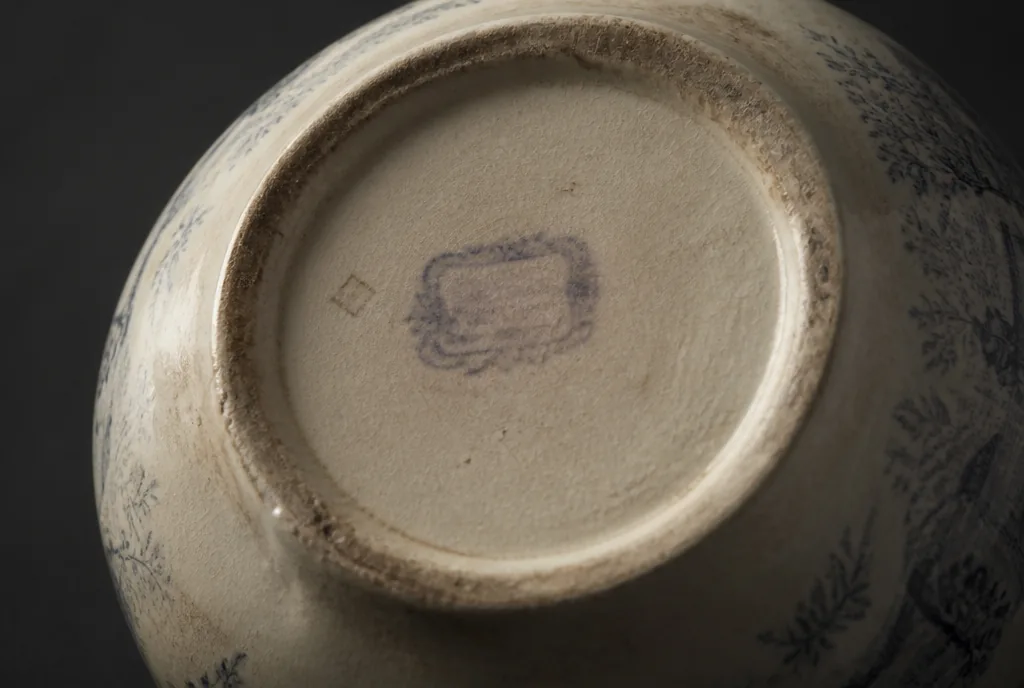
Quick answerA diamond-shaped mark on British ceramics means the design was registered between 1842 and 1883, going by The National Archives (thepotteries.org gives 1843 to 1882). Starting in 1884, registration switched to consecutive Rd numbers, marked “Rd” or “Rd No.” Either kind gives the earliest date the piece could have been made, not the year it was made.
Registration marks are a precise dating clue on British pottery and porcelain, because each one decodes to a specific day or a narrow span of years. This guide shows how to read both kinds. What it can’t tell you is when your particular piece left the factory: a registered shape or pattern could stay in production for many years afterwards.
What a registration mark is (and isn’t)
The Designs Act of 1842 introduced the diamond mark and sorted registered designs by material. Earlier registrations, from 1839, only divided wallpaper from everything else. The diamond was printed, engraved or otherwise put on an object to show that its design was registered.
Two things often get confused with it. The first is the manufacture date, which the mark doesn’t record. The second is the pattern number, which is the factory’s own internal code and has nothing to do with the national register.
Reading the diamond, 1842 to 1883
Start at the top. A Roman numeral there gives the material class: ceramics is class IV, metal is class I and glass is class III. If your ceramic piece shows IV, you’re reading the right kind of mark.
Then work out which layout you have. thepotteries.org describes two:
- 1842 to 1867: year letter at the top, month letter at the left, day number at the right.
- 1868 to 1883: day number at the top, month letter at the bottom, year letter at the right.
Using the wrong layout is a common decoding mistake, because the same letters repeat across both periods. X means 1842 in the first layout and 1868 in the second.
- Confirm the class numeral. IV means ceramics.
- Find the year letter. If the top corner holds a letter, use the 1842 to 1867 column below. If that corner holds a day number and a letter sits in the right corner, use the 1868 to 1883 column.
- Look up the month letter in the second table.
- Read the day number.
- Write the result as a full date. That’s the day the design was registered.
Year letters
| Letter | 1842 to 1867 layout (letter at top) | 1868 to 1883 layout (letter at right) |
|---|---|---|
| X | 1842 | 1868 |
| H | 1843 | 1869 |
| C | 1844 | 1870 |
| A | 1845 | 1871 |
| I | 1846 | 1872 |
| F | 1847 | 1873 |
| U | 1848 | 1874 |
| S | 1849 | 1875 |
| V | 1850 | 1876 |
| P | 1851 | 1877 |
| D | 1852 | 1878 |
| Y | 1853 | 1879 |
| J | 1854 | 1880 |
| E | 1855 | 1881 |
| L | 1856 | 1882 |
| K | 1857 | 1883 |
| B | 1858 | not used |
| M | 1859 | not used |
| Z | 1860 | not used |
| R | 1861 | not used |
| O | 1862 | not used |
| G | 1863 | not used |
| N | 1864 | not used |
| W | 1865 | 1878 (alongside D) |
| Q | 1866 | not used |
| T | 1867 | not used |
The letters come from The National Archives’ research guide. Note that 1878 had two letters in the second layout, D and W.
Month letters (both layouts)
| Letter | Month | Letter | Month |
|---|---|---|---|
| C | January | I | July |
| G | February | R | August |
| W | March | D | September |
| H | April | B | October |
| E | May | K | November |
| M | June | A | December |
Sources differ on the diamond’s start and end. The National Archives gives 1842 to 1883. thepotteries.org gives 1843 to 1882 on its general page and 1843 to 1867 for the first layout, even though its own year table lists X for 1842. Registrations began in late 1842, so the first diamond-marked goods could date from 1842 or 1843.
Rd numbers, 1884 onward
In 1884 the diamond gave way to consecutive numbers, marked “Rd” or “Rd No.” Number 1 was issued in 1884, and the count simply kept going. To date one, find the two listed years it falls between.
The table below gives the first number issued in selected years, from thepotteries.org. It only lists every fifth year, so it dates a number to a five-year span, not a single year. We haven’t extended it past 1965 because our source data stops there.
| Year | First Rd number that year | A number in this range was registered in |
|---|---|---|
| 1884 | 1 | 1 to 141272: 1884 to 1889 |
| 1890 | 141273 | 141273 to 246974: 1890 to 1894 |
| 1895 | 246975 | 246975 to 351201: 1895 to 1899 |
| 1900 | 351202 | 351202 to 447799: 1900 to 1904 |
| 1905 | 447800 | 447800 to 551999: 1905 to 1909 |
| 1910 | 552000 | 552000 to 644934: 1910 to 1914 |
| 1915 | 644935 | 644935 to 673749: 1915 to 1919 |
| 1920 | 673750 | 673750 to 710164: 1920 to 1924 |
| 1925 | 710165 | 710165 to 751159: 1925 to 1929 |
| 1930 | 751160 | 751160 to 799096: 1930 to 1934 |
| 1935 | 799097 | 799097 to 837519: 1935 to 1939 |
| 1940 | 837520 | 837520 to 842669: 1940 to 1944 |
| 1945 | 842670 | 842670 to 860853: 1945 to 1949 |
| 1950 | 860854 | 860854 to 876066: 1950 to 1954 |
| 1955 | 876067 | 876067 to 894999: 1955 to 1959 |
| 1960 | 895000 | 895000 to 919606: 1960 to 1964 |
| 1965 | 919607 | 919607 and up: 1965 or later |
Suppose a plate reads “Rd No 600000.” That falls between 552000 (first number of 1910) and 644935 (first of 1915), so the design was registered sometime from 1910 to 1914. The plate itself was made in 1910 or later.
Some published Rd tables differ slightly from this one. If your number sits close to a boundary, check a second table before you rely on the year, and allow for the span either side.
Looking up the original registration
The registers themselves survive at The National Archives at Kew, along with the representations of each design. The series to know:
- BT 43 to 44: ornamental designs, 1842 to 1884 (the diamond years).
- BT 50 to 51 and BT 53: numbers 1 to 518643, covering 1884 to 1908.
- BT 52 to 53: non-textile numbers from 518644 onward.
Some series can be searched in The National Archives’ Discovery catalog by design number, proprietor or description. For diamond marks, decode the diamond first, then browse BT 43 by class and year. A match can give you the proprietor who registered the design, which is sometimes more useful than the date.
Putting it together
A decoded diamond or Rd number gives you a firm “not before” date. Pair it with the maker’s working dates and the other wording in the mark, such as “England” or “Made in England”, to close the range from the other side. Then look the maker up in the Mark Finder or our pottery and porcelain entries. Keep any pattern number separate in your notes; it belongs to the factory, not the register.
Sources
Questions people ask
Is the Rd number the year my piece was made?
No. It dates the registration of the design, which is the earliest the piece could have been made. The shape or pattern may have stayed in production for many years afterwards.
What does the Roman numeral at the top of the diamond mean?
It gives the material class of the registered design. Ceramics is class IV; metal is class I and glass is class III.
Can I find out who registered the design?
The National Archives at Kew holds the registers. Some series can be searched in its Discovery catalogue by design number, proprietor or description, and diamond-mark registrations can be found by decoding the diamond and browsing BT 43 by class and year.
What is the difference between an Rd number and a pattern number?
An Rd number comes from the national design register, marked "Rd" or "Rd No." A pattern number is the factory's own internal code, so it can't be dated with the Rd table.
The Mark Index is a reference for identifying and dating marks. It isn’t an appraisal or a guarantee of authenticity. Reproductions and later reissues can carry old marks.