What the copyright symbol on costume jewelry tells you
The © points to the mid-1950s or later, thanks to a 1955 Trifari case. Here's why it isn't a hard cutoff, and what a copyright year really dates.
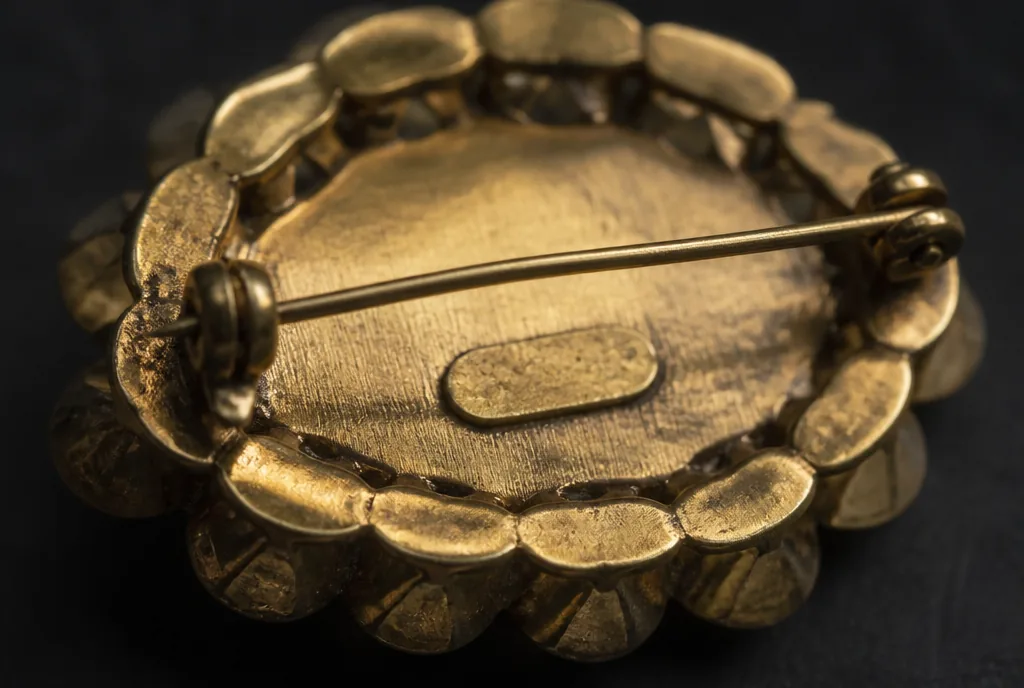
Quick answerA © symbol on costume jewelry usually means the design dates from the mid-1950s or later. A 1955 federal court ruling in a Trifari case confirmed that costume jewelry designs could be copyrighted, and most makers then switched from design patents to copyright. It isn’t a strict “after 1955” rule, though: Trifari stamped © on its pieces in 1954 and 1955, and some Hollycraft pieces carry “COPR 1950”.
The copyright notice is one of the handiest clues on the back of a brooch or clasp, because it points to a period rather than a maker. This guide explains where the mid-1950s line comes from, why it’s softer than many listings claim, and how to read a notice that carries a year. What it can’t do is give you a year of manufacture. A © tells you roughly when the design was protected, and a piece could have been made for years after that.
Where the mid-1950s line comes from
Two court cases sit behind it. In 1954 the US Supreme Court decided Mazer v. Stein, holding that artistic works used in mass-produced useful objects could be copyrighted. The objects in that case were statuettes used as lamp bases. That decision formed the backdrop for copyrighting jewelry designs.
The jewelry case followed in 1955. Trifari, Krussman & Fishel, Inc. v. Charel Co. (134 F. Supp. 551) came before the US District Court for the Southern District of New York. Trifari wanted an injunction to stop Charel from copying one of its copyrighted costume jewelry pieces.
Charel argued that “junk jewelry” couldn’t be copyrighted at all, that the design lacked originality, and that Trifari’s copyright notice was inadequate. The court disagreed. According to the case summary, costume jewelry is entitled to copyright protection whatever its artistic standing. Costume Jewelry Collectors International (CJCI), in an article by Robin Deutsch, reports that Judge Alexander Bicks ruled on 9 November 1955 that costume jewelry is a work of art whose original designs could be registered for copyright.
Why makers switched from patents to copyright
Before the ruling, the big firms protected designs with design patents. From the 1930s to the mid-to-late 1950s, Trifari and Coro patented hundreds of costume jewelry designs. Patents were a poor fit for seasonal fashion, though. CJCI reports that design patents lasted only 3.5 to 7 years for these makers, cost about $60 each, and took three months to a year to be granted.
Copyright lasted 25 years and was faster and cheaper. After the 1955 decision, most costume jewelry firms dropped design patents in favor of it. Coro was the exception: it kept patenting until 1965.
That’s the practical reason the © shows up on so much jewelry from the second half of the 1950s onward. Makers had a cheaper tool, and they used it.
Why “after 1955, no exceptions” is too strong
Many collector sites state that any piece with a © dates after 1955, with no exceptions. Our sources don’t support that. They record copyright notices on jewelry before the November 1955 ruling.
- Trifari’s Carl Fishel reported stamping the copyright symbol on all pieces in 1954 and 1955. The company was testing enforcement in the courts before the ruling came down.
- CJCI cites Hollycraft pieces marked with a copyright year of 1950.
So we use the phrase “mid-1950s or later”. It covers the bulk of ©-marked costume jewelry without ruling out the early Trifari and Hollycraft notices.
A missing © proves nothing on its own. Plenty of later pieces carry no copyright notice, and Coro kept using patents rather than copyright through 1965. Don’t call a piece pre-1955 just because the symbol isn’t there.
Reading a notice that includes a year
Some makers stamped the year along with the notice. CJCI gives the Hollycraft example:
A dated notice like this can date a piece closely, but read it for what it is. The year belongs to the copyright on the design. A popular design could stay in production for years after it was registered, so treat the year as the earliest likely date for that design and not the date your piece left the factory.
What each kind of notice tells you
Use this table with the piece in hand, and read every mark on it before deciding. A notice rarely tells the whole story by itself.
| What you see | What it suggests | What it doesn’t prove |
|---|---|---|
| © next to a maker’s name | The design is roughly mid-1950s or later | An exact year, or that it can’t be from 1954 or 1955 |
| COPR or © with a year (e.g. COPR 1950) | The design was copyrighted that year; a close date for the design | The year the piece was made; production could continue for years |
| A patent number or “Pat. Pend.” | Probably a design protected by patent, the usual route before the mid-1950s | A pre-1955 date if the maker is Coro, which patented through 1965 |
| Maker’s name only, no © and no patent | Nothing about date by itself | That the piece is pre-1955 |
A timeline to keep in mind
| Date | What happened |
|---|---|
| 1930s to mid/late 1950s | Trifari and Coro patent hundreds of costume jewelry designs |
| 1950 | Year seen in “COPR 1950” notices on some Hollycraft pieces |
| 1954 | Supreme Court decides Mazer v. Stein |
| 1954 to 1955 | Trifari reports stamping © on all its pieces |
| 9 November 1955 | Judge Alexander Bicks rules in the Trifari v. Charel case (per CJCI) |
| After 1955 | Most costume jewelry firms move from design patents to copyright |
| Until 1965 | Coro keeps patenting designs |
The case details here come from a search-result summary of the court opinion and from CJCI’s account; we weren’t able to open the full opinion text directly. The Mazer v. Stein summary likewise comes from a search-result snippet.
Putting it together
Start by reading every mark on the piece, not just the ©. A maker’s name narrows the field faster than any notice, and a patent number can be looked up for its issue date (see our guide to patent numbers and “Pat. Pend.” as dating tools). Then use the © or COPR year as a lower bound for the design: mid-1950s or later for a plain ©, and the stated year for a dated notice.
If you know the maker, check its entry for how its marks changed over time, for example Trifari, Coro or Hollycraft. If you only have a fragment of a mark, try the Mark Finder.
Sources
- Foiling the Style Pirates: Costume Jewelry Exclusives, Patents and Copyrights (Robin Deutsch) – Costume Jewelry Collectors Int’l
- Vintage Costume Jewelry Tools for Dating – Costume Jewelry Collectors Int’l
- Trifari, Krussman & Fishel, Inc. v. Charel Co., 134 F. Supp. 551 (S.D.N.Y. 1955) – Justia
- Mazer v. Stein – Wikipedia
Questions people ask
Does a © on costume jewelry mean the piece was made after 1955?
Not strictly. Trifari reported stamping © on all its pieces in 1954 and 1955, before the November 1955 ruling, and some Hollycraft pieces carry COPR 1950. 'Mid-1950s or later' is the safer reading.
Why did jewelry makers switch from patents to copyright?
Design patents lasted only 3.5 to 7 years for these makers, cost about $60 and took three months to a year to be granted. Copyright lasted 25 years and was faster and cheaper, so most firms switched after the 1955 decision.
Did Coro use the copyright symbol after 1955?
Coro was the exception among the big firms. It kept patenting its designs until 1965, so a Coro piece without a © isn't necessarily from before 1955.
What was Mazer v. Stein?
It was a 1954 US Supreme Court decision holding that artistic works used in mass-produced useful objects, in that case lamp-base statuettes, could be copyrighted. It formed the backdrop for copyrighting jewelry designs.
The Mark Index is a reference for identifying and dating marks. It isn’t an appraisal or a guarantee of authenticity. Reproductions and later reissues can carry old marks.