Why 1940s costume jewelry is often marked Sterling
Wartime metal restrictions sent costume jewelers to sterling silver. Here's what the stamp means on a US piece, and why it fits the 1940s without proving it.
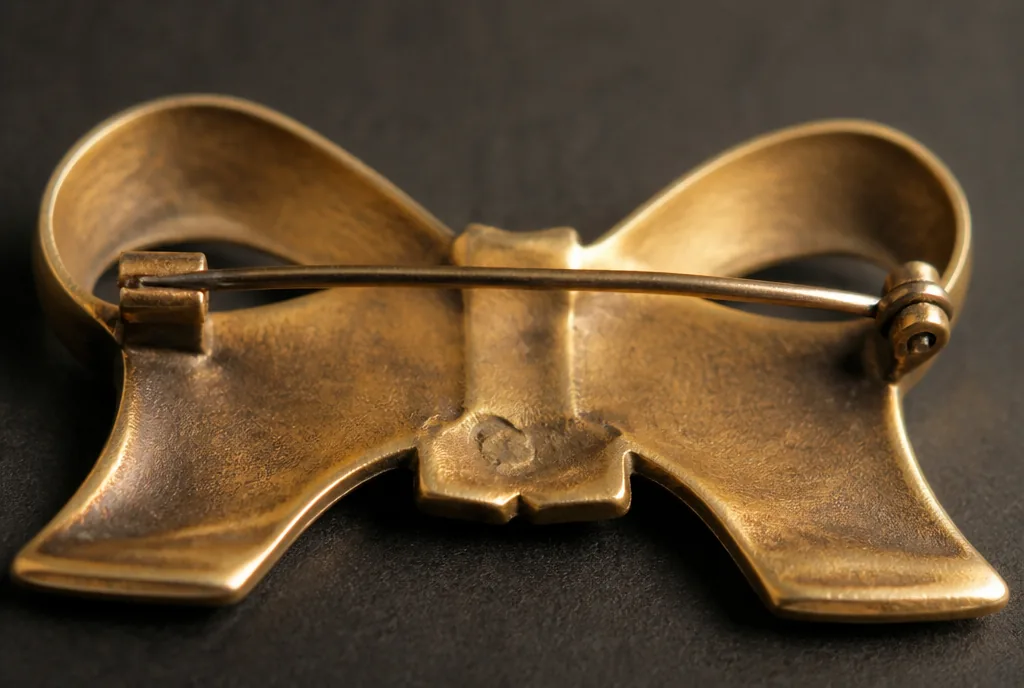
Quick answerA lot of 1940s costume jewelry is marked Sterling because of World War II. Base metals went to military production and their use was banned in the private sector, so costume jewelers switched to sterling silver. A Sterling mark on a costume piece fits the 1940s well, but it doesn’t prove a war date, since sterling was used before and after the war too.
This guide explains why sterling turns up on so much wartime costume jewelry, what the Sterling stamp legally means on a US piece, and which other marks on the same piece can tighten the date. It can’t give you exact start and end years for a “sterling era”. None of our sources name the government order behind the restrictions or the dates they began and ended, so we don’t draw hard lines around it.
What changed during the war
White metal was the standard casting alloy for costume jewelry: tin and lead, with bismuth, antimony, cadmium or copper added. During the war it became unavailable, because lead and tin were reserved for armaments.
More broadly, base metals were needed for military production, and their use was banned in the private sector. The big firms felt it directly. Coro and Trifari both converted part of their factories to make military parts.
Sterling filled the gap. It worked as a substitute because, like the base metals it replaced, it could imitate the look of platinum. In the 1940s sterling silver was then widely used for metal costume jewelry, in both cast and die-struck pieces.
Demand didn’t fall off either. A 1943 New York Times article on war styles, reproduced by Costume Jewelry Collectors International (CJCI), noted rising demand for costume jewelry and new materials such as acetate “emeralds” set in silver.
What “Sterling” means on a US piece
The word on the back is a legal claim, not decoration. Under federal law, a US item stamped “Sterling” must be 925 silver within the legal tolerance. The mark reads:
A second federal rule matters for dating. Since late 1961, a US quality mark such as “Sterling” must sit next to a registered trademark or the maker’s name. A US piece stamped Sterling with no maker’s name or trademark beside it doesn’t meet the rule in force since then. That is consistent with an earlier piece, but it doesn’t prove one on its own; treat it as one clue among several.
For more on the difference between sterling, coin silver and silverplate marks, see our guide to sterling vs. coin silver vs. silverplate. For number marks like 925, see silver purity numbers.
Other marks that narrow the date
The Sterling stamp tells you the metal. The maker’s name and any patent number tell you more about when.
From the 1930s into the 1950s, Trifari and Coro patented many designs, so a 1940s sterling piece from one of those firms may also carry a patent number. That number can be converted to the year the patent issued. Our guide to patent numbers and “Pat. Pend.” includes a table of first design patent numbers by year and explains the limits: a patent year is when the design was protected, not necessarily when your piece was made.
If the piece has a maker’s name, the maker’s entry is the next stop, since a maker’s mark styles often help place a piece within its history.
Checklist: reading a sterling costume piece
- Find the quality mark and read it exactly. “Sterling” on a US piece is a claim of 925 silver.
- Look for a maker’s name or trademark next to it. If there is one, look up the maker. If there isn’t, remember that US pieces made since late 1961 should have one.
- Look for a patent number or “Pat. Pend.” and convert any number to its issue year with the patent guide.
- Check the construction. Sterling was used for both cast and die-struck costume pieces in the 1940s, so either is possible.
- Don’t rule out sterling because the piece is gold-colored. Collectors widely repeat that many war-era pieces are gold-plated sterling (vermeil), though none of the sources we opened confirmed it. The stamp is what counts.
- Put the clues together. Sterling plus a 1940s patent year plus a maker whose entry records sterling work in the war years makes a strong case. Sterling alone makes a weak one.
What the metal suggests, and what it doesn’t
| What you see | What it suggests | Caution |
|---|---|---|
| Costume piece stamped Sterling | Fits the 1940s, when sterling was widely used for costume jewelry | Sterling was also used before and after the war |
| Sterling plus a patent number | The patent’s issue year gives a date for the design | Production could run on after the patent issued |
| Sterling with no maker’s name beside it (US piece) | Doesn’t meet the trademark rule in force since late 1961 | Not proof of an earlier date by itself |
| Cast piece in white metal | The standard casting alloy, which became unavailable during the war | Our sources don’t give the dates white metal disappeared or returned |
Don’t assume every sterling costume piece is from the 1940s. Sterling was used before and after the war, and our sources don’t document when the wartime shift began or ended. Use the other marks to confirm.
Putting it together
A Sterling stamp on costume jewelry is a good reason to think about the 1940s, and a poor reason to stop there. Read the maker’s name, look up any patent number, and check the maker’s entry, for example Trifari or Coro, both of which converted part of their factories to military work during the war. If you can’t place the mark, try the Mark Finder.
Sources
- Costume jewelry – Wikipedia
- Jewelry Manufacturing Concepts Part I (Mary Ann Docktor-Smith) – Costume Jewelry Collectors Int’l
- 1943 article: Simple War Styles Bring Increased Demand for Costume Jewelry – Costume Jewelry Collectors Int’l
- Vintage Costume Jewelry Tools for Dating – Costume Jewelry Collectors Int’l
- 15 U.S. Code 296 – Silver articles; stamping – Cornell LII
- 15 U.S. Code 297 – Stamping plated articles; trademark requirement – Cornell LII
Questions people ask
Why did costume jewelers use sterling during World War II?
Base metals were needed for military production and banned in the private sector, and white metal became unavailable because lead and tin were reserved for armaments. Sterling could imitate the look of platinum, as the base metals had.
Is a piece stamped Sterling real silver?
Under US federal law, an item stamped Sterling must be 925 silver within the legal tolerance. The law applies to US pieces.
When did the Sterling mark have to include a maker's name?
Since late 1961, a US quality mark such as Sterling must sit next to a registered trademark or the maker's name.
Did big jewelry companies stop making jewelry in the war?
Our sources say Coro and Trifari converted part of their factories to make military parts. A 1943 New York Times article reported rising demand for costume jewelry, including acetate 'emeralds' set in silver.
The Mark Index is a reference for identifying and dating marks. It isn’t an appraisal or a guarantee of authenticity. Reproductions and later reissues can carry old marks.