Mexican silver marks: the eagle, registry codes like TS-24 and 925
The eagle mark, the registry codes that replaced it and the purity marks beside them place a Mexican piece in its period. Here's how to read each one.
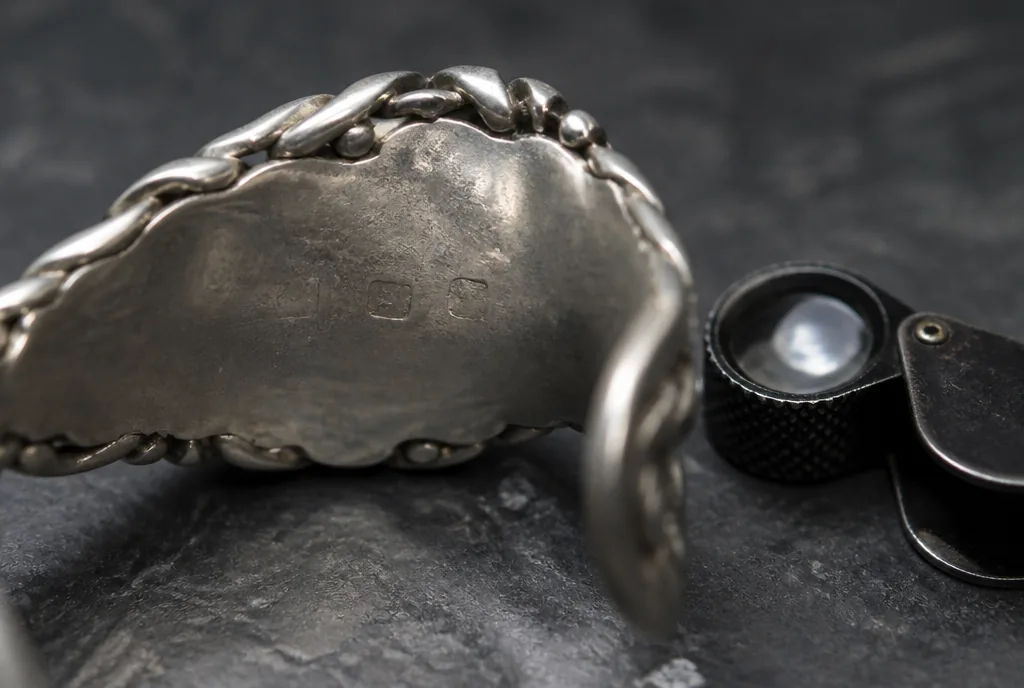
Quick answerMexican silver marks date in three broad stages. From 1948, registered makers stamped a national eagle mark with their own number inside it. The eagle was dropped in 1979–80 (some sources say about 1980) for an alphanumeric registry code such as TS-## for Taxco, which identifies the maker, not the purity. Work from the 1930s and early 1940s usually carries workshop marks only, so a missing eagle isn’t a warning sign on its own.
This guide helps you place a Mexican silver piece in one of those periods from the marks alone, and read the purity marks that sit beside them. It won’t identify the maker behind a particular registry code. We couldn’t find an official Mexican government source for how the codes are assigned, so we explain the format and stop there.
First, is it silver?
Check the purity mark before anything else. On Mexican pieces, “925” and “Sterling” both mean the 925 standard. A piece marked “Alpaca” is nickel silver and contains no silver at all.
The word “Mexico” on its own says where a piece was made. It says nothing about the metal, so don’t read it as a silver mark.
For more on 925 and other purity numbers, see our guide to silver purity numbers.
Before the eagle: workshop marks (1930s to early 1940s)
Silversmithing had existed in Taxco since the colonial period. William Spratling organized it into a modern workshop system with identifiable hallmarks, beginning with the workshop he founded there in 1931, Taller de las Delicias.
Pieces from the 1930s and early 1940s, made before the national eagle, carry workshop marks only. That’s expected, so a Mexican piece without an eagle may simply be early work. It isn’t automatically a fake, and it isn’t automatically post-1980.
The eagle mark (1948 to 1979–80)
In 1948 Mexico introduced a national eagle mark tied to registered production and minimum silver standards. Each registered maker received a number, which appears inside the eagle. The number identifies the registered workshop.
One secondary hallmark blog cites examples: Eagle 3 for the Taxco district, Eagle 9 for Hector Aguilar (Taller Borda) and Eagle 17 for Antonio Pineda. We haven’t checked those assignments against a dedicated Mexican silver reference, so treat them as a lead and confirm them before you rely on one.
The system ended in 1979–80, according to Wikipedia. The same secondary blog puts it at about 1980. The two accounts agree closely enough for dating, but neither gives an exact day.
Registry codes (about 1980 onward)
The eagle’s replacement was a federal alphanumeric registry. According to the secondary hallmark blog, the codes follow a pattern of state letters, maker initials and a serial number. Its example is TS-## for Taxco, where ## stands for the maker’s serial number.
Keep these points straight about the codes:
- A code like TS-24 identifies a registered maker. It is not a purity mark; purity appears separately, as 925.
- We haven’t verified any specific code, TS-24 included, to a named maker, and we don’t list code-to-maker matches.
- The TS = Taxco reading comes from a secondary source. No official government source for the format turned up in our research.
What the code does tell you with confidence is the period. A registry code instead of an eagle points to a piece made after the switch in 1979–80.
Don’t treat a TS code as proof of silver content, and don’t trust any listing that names a maker for a code without citing a registry source. The code and the purity mark are separate marks that say different things.
Which period is it? A quick lookup
| What you see | Likely period | Notes |
|---|---|---|
| Workshop mark only, no eagle, no code | 1930s to early 1940s is possible | Early work predates the eagle; a missing eagle isn’t a fake sign by itself |
| Eagle with a number inside | 1948 to 1979–80 | The number identifies the registered workshop |
| Letters and a number, e.g. TS-## | About 1980 onward | Identifies the maker, not the purity |
| 925 or Sterling | Any period | Both mean the 925 standard |
| Alpaca | Any period | Nickel silver, no silver content |
| “Mexico” alone | Any period | Country of origin, not a silver mark |
Mexican pieces also usually carry a design number alongside the workshop hallmark. Collectors rely on published hallmark chronologies for each workshop to pin down the maker and date, and those are worth consulting once you’ve placed a piece in its broad period.
Spratling marks as an example of a workshop chronology
William Spratling’s marks show how much a single workshop’s stamps can shift over a career. He lost control of Taller de las Delicias in 1946 and restarted a small workshop at Taxco el Viejo in 1952. His marks changed across those years:
| Mark | Approximate dates |
|---|---|
| Interlocking WS monogram | Early |
| “Spratling Made in Mexico” with an oval “Spratling Silver” stamp | About 1938–1945 |
| “Spratling de Mexico” | About 1949–1951 |
| “William Spratling Taxco Mexico” | Later |
The dates are approximate in our source, and it doesn’t give years for the first and last marks. Use the wording to narrow a range, not to name a year.
Putting it together
Start with the purity mark and set aside anything marked Alpaca. Then look for the eagle or a registry code and use the lookup table to place the piece before 1948, between 1948 and 1979–80, or after. Read the workshop hallmark and design number last, against a published chronology for that workshop.
For marks from other countries, browse the silver section or read our guide to sterling vs. coin silver vs. silverplate. If you can’t match the hallmark, try the Mark Finder.
Sources
Questions people ask
Does 'Mexico' on a piece mean it's silver?
No. 'Mexico' alone isn't a silver mark. Look for 925 or Sterling, which both mean the 925 standard; 'Alpaca' means nickel silver with no silver content.
Who was William Spratling?
Spratling founded the Taxco workshop Taller de las Delicias in 1931 and organized Taxco's silversmithing into a modern workshop system with identifiable hallmarks. He lost control of the workshop in 1946 and restarted a small one at Taxco el Viejo in 1952.
Can you tell me which maker a TS code belongs to?
We don't match codes to makers. We found no official Mexican source for the registry, and no specific code, TS-24 included, was verified to a maker in our sources.
The Mark Index is a reference for identifying and dating marks. It isn’t an appraisal or a guarantee of authenticity. Reproductions and later reissues can carry old marks.