Sterling, coin silver or silverplate: how to tell from the marks
STERLING and COIN have legal meanings on American silver, and plate may not use either word. Here is how to sort a piece from its marks, including the unmarked ones.
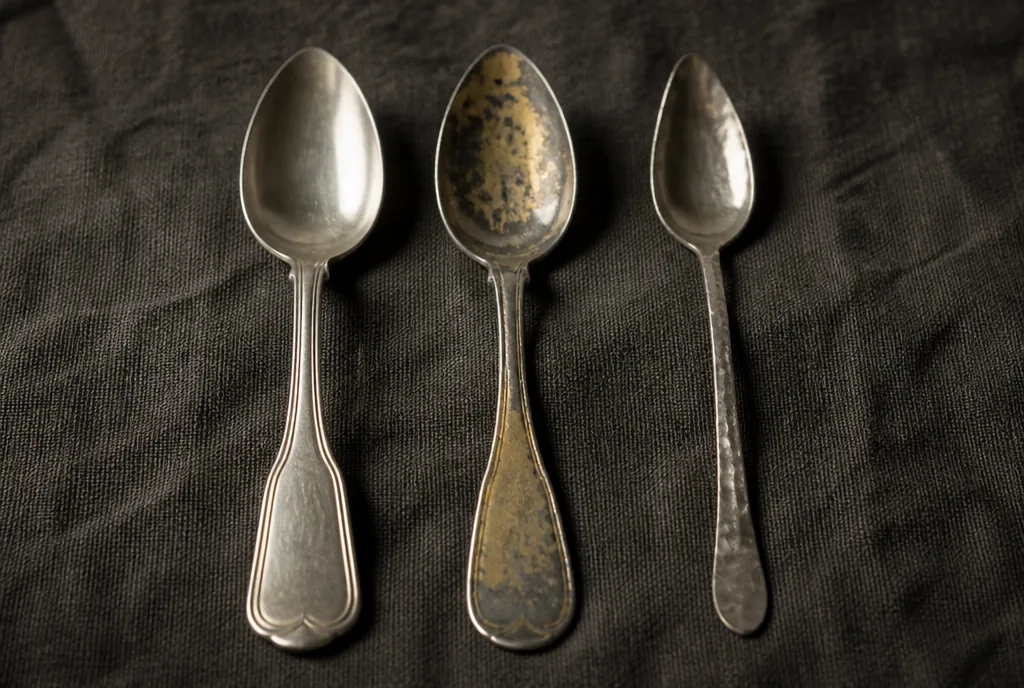
Quick answerOn American silver, STERLING or 925 means 925 parts per thousand pure silver, and COIN means 900; federal law sets both numbers and forbids either word on plated goods. EPNS or a plate trade name such as 1847 Rogers Bros. means silverplate: a thin skin of silver over base metal. A piece with no purity word at all can still be solid early American coin silver.
This guide helps you sort a spoon, cup or tray into one of three groups from the marks on it: sterling, coin silver or silverplate. It works best on American pieces, because the rules we cite are American. It can’t give you an exact date for most items, and it can’t prove what an unmarked piece is made of. For that, you need a test, not a stamp.
The three words, and what the law says they mean
Start with the words, because in the United States they have a legal meaning. Under 15 U.S.C. 296, an article may be marked “sterling” or “sterling silver” only if it contains 925 parts per thousand pure silver. “Coin” or “coin silver” is allowed only at 900 parts per thousand. The law gives a tolerance of 4 parts per thousand either way.
The next section of the code, 15 U.S.C. 297, bans the words “sterling” and “coin” from silver-plated articles, alone or combined with other words. So a mark like “sterling plate” breaks the rule on its face. If a piece is plated, the law says it shouldn’t use either word at all.
| What the mark says | What it means | Notes |
|---|---|---|
| STERLING, STERLING SILVER, 925, 925/1000 | Solid silver, 925 parts per thousand | US legal standard, tolerance of 4 parts per thousand |
| COIN, COIN SILVER | Solid silver, 900 parts per thousand | US legal standard for the word “coin” |
| STANDARD, DOLLAR, or an eagle | Often a coin-silver mark | Used by American silversmiths from the 1830s on |
| A name or initials only | Could be coin silver | Typical of early American makers, who had no hallmarking system |
| No mark at all | Undetermined | Common on early American silver into the 1850s |
| EPNS | Electroplated nickel silver | Thin silver coating over base metal |
| A plate trade name, e.g. 1847 Rogers Bros. | Silverplate | A trademark, not a date or a purity |
Coin silver: the 900 standard and the unmarked years
According to McHale Silverwares, a 900 standard became usual among American silversmiths in the 1830s. Makers often signaled it with a word or a symbol rather than a number:
An eagle served the same purpose on some pieces. Before sterling took over, much American silver came from melted coins, and Wikipedia’s hallmark article puts its purity anywhere from about 750 to about 900. That range matters. “Coin silver” in the older, looser sense doesn’t guarantee the 900 that the modern law requires.
Many early American pieces carry no purity word whatever. McHale notes that completely unmarked silver wasn’t unusual into the 1850s, and that colonial makers typically struck only their initials or a name. England had a hallmarking system; America had nothing like it. Baltimore was the one early exception, running its own assay office between 1814 and 1830.
Don’t write off an unmarked or name-only early American piece as plate. Much coin silver was never marked with a purity word. The absence of STERLING or COIN tells you nothing on its own about what the metal is.
Sterling: when 925 became the American norm
The 925 standard came to America from England. Tiffany’s press site says that in 1851 the firm contracted New York silversmith John C. Moore, who worked to the English sterling standard of 925, and that this standard was later adopted across the United States. McHale adds that some New York firms, Tiffany and Ball & Black among them, used sterling in the 1850s.
Sources differ on when sterling became general. Wikipedia gives 1868 as the year it became the American standard, after which pieces were marked STERLING, 925 or 925/1000. McHale describes a gradual shift: most US makers moved to sterling after the Civil War, and it was written into law by the 1906 Stamping Act. Keep in mind what that Act did. It regulated the accuracy of quality marks; it didn’t require anyone to mark silver at all.
For dating, the practical reading is broad. A piece marked STERLING is most likely from after the Civil War, with 1850s New York work as the early edge. A piece marked COIN, or with an eagle, sits more comfortably in the decades before.
Maker’s name next to the quality mark
An amendment effective 4 December 1961 added a second requirement. Any article bearing a gold or silver quality mark must also carry the maker’s or seller’s registered trademark or name, applied the same way and close to the quality mark. Look for the name beside the word STERLING. Some firms, including Tiffany, Reed & Barton and Gorham, also used their own date-marking codes, which a maker-specific reference can decode.
Silverplate: base metal with a silver skin
Electroplating coats a base-metal object with a thin layer of silver using electric current. The SFO Museum credits George Richards Elkington of Birmingham, England, with patenting the process in 1840. In America, Rogers Brothers of Hartford began electroplated flatware in 1847, and the Meriden Britannia Company industrialized silverplating in the following decade.
That 1847 date is where a lot of confusion starts.
This is a silverplate trademark. The number isn’t the year your spoon was made, and it isn’t a purity. Read it the same way you’d read any other brand name.
Plate marks also include letter codes. EPNS means electroplated nickel silver: the silver is only a thin coating. Nickel silver itself, sometimes called German silver, is a copper-nickel-zinc alloy with no silver in it. Our guide to silverplate abbreviations covers EP, EPBM, A1 and the rest.
Older than electroplate is Sheffield plate, made before the 1840s by fusing silver onto copper. The Silver Society warns that both Sheffield plate and electroplate often carry marks that imitate hallmarks.
Pseudo-hallmarks: small pictures that aren’t proof
A row of tiny symbols (a lion, a head, an anchor) looks official. On American or English plate, it often isn’t, which is the Silver Society’s point about imitation hallmarks. A genuine British hallmark follows a set structure, which we explain in how to read British silver hallmarks.
When a piece shows little pictorial marks, look for a word or letter code nearby. EPNS or a plate trade name next to a lion settles the question: it’s plate. If the only marks are pictures, compare them against a real hallmark layout before you trust them.
A quick check, in order
- Find every mark on the piece and read all of them before deciding anything.
- Look for STERLING, 925 or 925/1000. On American silver, the law ties these to 925 parts per thousand.
- Look for COIN, STANDARD, DOLLAR or an eagle. These point to American coin silver.
- Look for EPNS, another plate code, or a plate trade name such as 1847 Rogers Bros. Any of these means silverplate.
- If you see only small pictorial marks, treat them as possible pseudo-hallmarks until you’ve matched them to a real hallmark system.
- If you see only a name or initials, or nothing, don’t conclude plate. Early American coin silver often looked exactly like this.
- Note any maker’s name beside the quality mark, and any maker’s date code, for later research.
Putting it together
The word on the piece does most of the work. STERLING and COIN carry legal meaning in the United States, and plate isn’t allowed to borrow either one. Where the words are missing, go slower: early American silver was often unmarked or marked with a name alone, and plate often wears fake hallmarks.
Once you know which group you’re holding, take the maker’s name or symbol to the Mark Finder, or browse the silver hub. If the piece carries a plain number such as 800 or 835 instead of a word, our guide to silver purity numbers explains where each was used.
Sources
- 15 U.S. Code 296 – Silver articles; stamping – Cornell LII
- 15 U.S. Code 297 – Stamping plated articles; trademark requirement – Cornell LII
- American Coin Silver – McHale Silverwares
- Silver hallmarks – Wikipedia
- A Legacy of Sterling Silver – Tiffany & Co. press site
- Eclectic Taste: Victorian Silver Plate – SFO Museum
- Identify Your Silver – The Silver Society
Questions people ask
Is German silver or nickel silver real silver?
No. Nickel silver, also called German silver, is a copper-nickel-zinc alloy with no silver in it. EPNS means that alloy has been given a thin electroplated silver coating.
Did the 1906 Stamping Act require American silver to be marked?
No. The Act regulated the accuracy of quality marks that makers chose to apply. It did not require silver to be marked at all, which is one reason unmarked pieces still turn up.
Was any early American silver officially tested?
Baltimore ran its own assay office between 1814 and 1830. It was the one early exception to the general lack of assaying in the United States.
Why does a 1960s or later American piece show a company name beside STERLING?
An amendment to federal law effective 4 December 1961 requires any article with a gold or silver quality mark to also carry the maker's or seller's registered trademark or name. It must be applied the same way as the quality mark and close to it.
The Mark Index is a reference for identifying and dating marks. It isn’t an appraisal or a guarantee of authenticity. Reproductions and later reissues can carry old marks.