American Art Pottery Marks: Identify and Date Rookwood, Roseville, Weller and More
American art pottery is better marked than most ceramics, and several potteries built a date into the mark itself. This guide shows how to read the base, decodes Rookwood’s flame marks, and lists 25 makers’ marks with sourced date ranges, from Rookwood and Grueby to Roseville, Weller, McCoy and Frankoma.
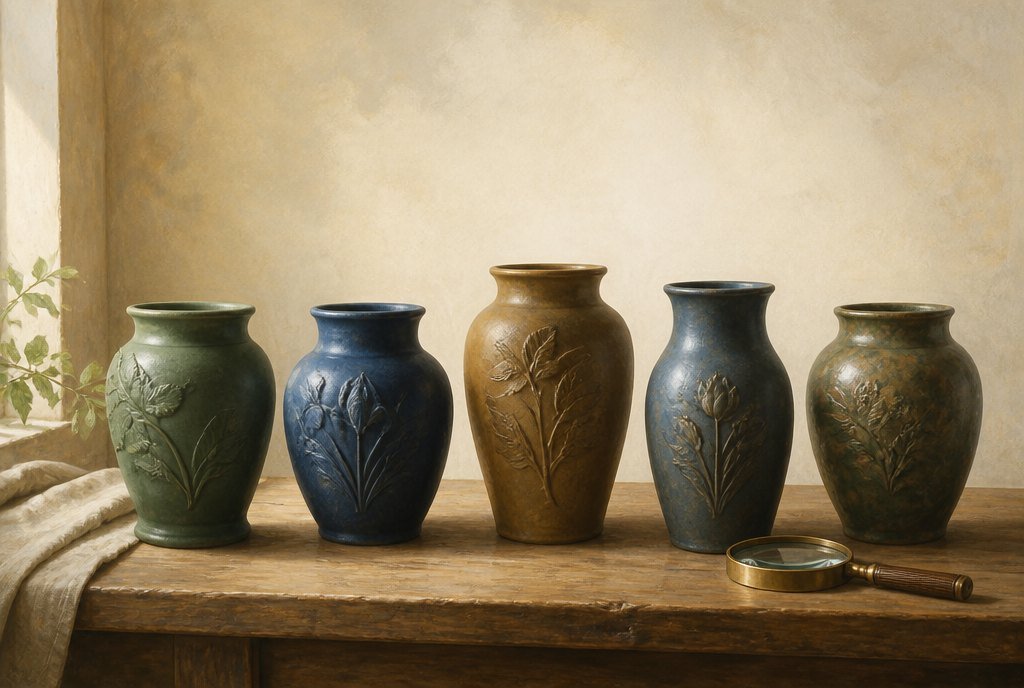
No ads · No sign-up
Free to copy, print and adapt under CC BY 4.0: just credit The Mark Index. No advertising, no affiliate links, no email wall on the printable. We never put values on anything.
Turn the piece over. Rookwood marked nearly everything:[3][4][5][7][18][19][20] count the flame points around the RP monogram and add them to 1886, or read the Roman numeral below the full mark as years after 1900.[3][5][7][19] Van Briggle pieces with a full year date from 1901 to about 1907 or 1912 to 1921.[3][15][16][29][30] At Roseville, a sunken script mark is the mid-to-late 1930s and raised “Roseville U.S.A.” is later.[3][9][12][21][22][23][24] Then check for copies: Chinese pieces with raised Roseville marks reached wholesalers in the 1990s, and new companies have registered old names.[12][23][24][59][75][77][95]
Three rules before you date art pottery
- A name proves less than it used to. Rookwood, Roseville, Weller, Niloak, Shawnee, McCoy, Teco and Bauer have all been registered again by later companies, some for new pottery made from old molds.[23][24][75][77]
- A blank base can be right. Roseville lines of about 1927 to 1935 carried only paper or foil labels, and McCoy marked nothing until about 1927 to 1929.[3][9][12][17][21][22][23][24][53][54][55][56]
- Numbers aren’t always years. Rookwood’s numerals are years, but Van Briggle’s early Roman numerals are clay codes, and most other numbers on a base are shape and size numbers.[3][5][7][9][12][15][16][17][19][29][30]
Narrow the date
Tap what you can see on the piece and pick the mark if there is one. The tool combines the ranges and shows which clue sets each limit. Only clues and marks with at least two independent sources are included.
Rookwood flame-mark decoder
Find the RP monogram (a reversed R joined to a P). Count the small flame points around it, then look below it for a Roman numeral.[3][5][7][19]
The one-page cheat sheet
The Rookwood flame count, the Van Briggle base sequence and every two-sourced mark on one page. Print it for a show, a club meeting or a reference desk.
Attribution line: “American Art Pottery Marks” by The Mark Index (https://themarkindex.com/american-art-pottery-marks/), licensed under CC BY 4.0.
How to read an art pottery base
- Impressed, incised, stamped or labeled
- Impressed marks were pressed into soft clay with a die; incised marks were scratched by hand; ink stamps sit on or under the glaze; raised marks were cut into the mold. Paper and foil labels fall off, which is why so much 1920s and 1930s ware is blank.[9][12][13][14]
- Decorator’s cipher
- Initials or a monogram scratched beside the factory mark mean a hand-decorated piece, from about 1880 into the 1930s and 1940s; at Rookwood the last decorators left in 1953.[3][5][6][7] A designer’s cipher molded into a shape is not the same as a signed piece.
- Molded production ware
- The big potteries moved to molded, undecorated lines: Rookwood from about 1904, Roseville in the early 1910s, and Weller’s art pottery gave way to commercial lines around 1920.[8][9][10]
- Matte glazes
- Grueby’s matte green (1897 to 1898) set off a fashion; Rookwood introduced its mat glaze about 1900 and vellum in 1904. Matte green alone isn’t a maker clue: Teco, Rookwood and Bauer made matte greens too.[3][5][11]
- “U.S.A.” and shape numbers
- Van Briggle added “U.S.A.” in 1922 and Roseville’s raised script carries it from the later 1930s. Grueby’s 1898 mark already read “Boston, U.S.A.”, so it is a floor for those two makers only.[12][15][16][17] A shape-and-size number molded with the mark (Roseville 728-10, for example) points to the mid-1930s or later at Roseville.[9][12][17]
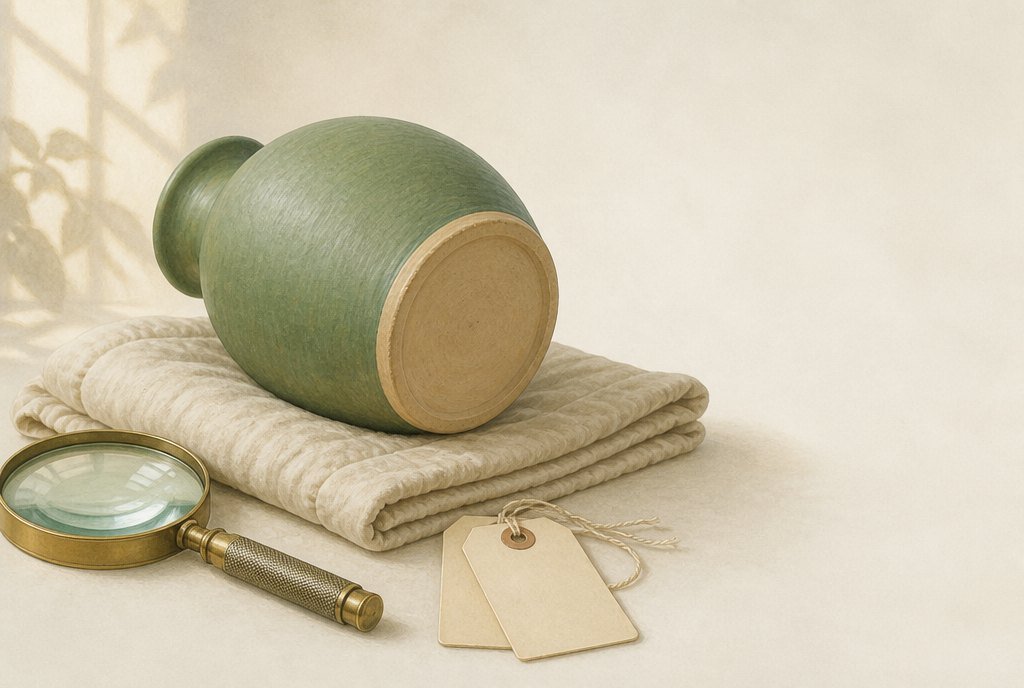
Art pottery marks at a glance
“About” marks a soft limit. The superscript numbers lead to the sources; “Maker” leads to the full entry.
| Clue or mark | Date range | Maker or note | Sources |
|---|---|---|---|
| Clues on any piece | |||
| American art pottery period (the window this page covers) | about 1880 to the 1940s-50s; the hand-decorated peak was about 1890-1929 | Details [1][2][3][4] | |
| Decorator's incised initials or cipher next to the factory mark (hand-decorated piece) | hand-decorated art pottery, about 1880 into the 1930s-40s; at Rookwood the last decorators left in 1953 | A designer's cipher molded into the shape is not the same as an individually signed piece (Rookwood Database). | Details [3][5][6][7] |
| Molded, undecorated production art ware (no decorator's cipher) from the big art potteries | from about 1904 at Rookwood; Roseville shifted in the early 1910s; Weller's art pottery gave way to commercial lines about 1920 | Details [8][9][10] | |
| Matte (mat, "dead") art-pottery glaze, e.g. Grueby green, Teco green, Rookwood mat and vellum | from about 1897-1900 onward (Grueby 1897-98; Rookwood mat about 1900, vellum 1904) | A floor only: matte glazes stayed in use for decades, and Grueby-style greens were imitated by Teco, Rookwood and Bauer (Wikipedia, Grueby). | Details [3][5][11] |
| No mark in the clay; maker identified only by a paper or foil label (or blank once the label is lost) | common in the late 1920s and 1930s: Roseville about 1926/27-1935, Weller 1920s-1930s; Hull used foil labels too | Earlier makers (Grueby, Teco, Marblehead, Newcomb) also used paper labels, but alongside an impressed mark. | Details [9][12][13][14] |
| "U.S.A." or "USA" incised or molded into the mark of Van Briggle or Roseville | Van Briggle from 1922 (with no year 1922-1926); Roseville raised script from about 1935-1940; many later Ohio potteries (McCoy, Hull) also used USA | A floor for these makers, not a universal rule: Grueby's 1898 lotus mark already read "Boston, U.S.A." (Just Art Pottery). | Details [12][15][16][17] |
| Shape-and-size number molded into the base with the mark (e.g. Roseville 728-10, Hull B-…, McCoy style numbers) | Roseville from the mid-1930s; McCoy style numbers became more common in later years | Details [9][12][17] | |
| Maker’s marks with two or more sources | |||
| Name of the pottery and the year, painted or incised by the decorator (variant: initials R.P.C.O.M.L.N.) | 1880 to about 1882 | Rookwood Pottery Company | Maker [3][4][5][7][18][19][20] |
| ROOKWOOD in block letters with the four-digit year | 1882 to 1886 | Rookwood Pottery Company | Maker [3][4][5][7][18][19][20] |
| RP monogram (reversed R joined to P), no flames | 1886 | Rookwood Pottery Company | Maker [3][4][5][7][18][19][20] |
| RP monogram with flame points around it, one added each year (1 flame = 1887 … 14 flames = 1900) | 1887 to 1900 | Rookwood Pottery Company | Maker [3][4][5][7][18][19][20] |
| RP monogram with all 14 flames and a Roman numeral below (I = 1901, II = 1902 …) | 1901 to 1967 | Rookwood Pottery Company | Maker [3][4][5][7][18][19][20] |
| Circle enclosing a rose with the name "Rozane Ware" (and other Rozane line marks, often with the line name) | about 1900 to about 1920 | Roseville Pottery Company | Maker [3][9][12][21][22][23][24] |
| "Rv" script monogram in blue ink under the glaze | about 1915 to about 1926 | Roseville Pottery Company | Maker [3][9][12][21][22][23][24] |
| Paper or foil label only (small black triangle; later silver or gold foil, often shield-shaped "ROSEVILLE POTTERY"), nothing in the clay | about 1926 to about 1935 | Roseville Pottery Company | Maker [3][9][12][21][22][23][24] |
| "Roseville" in script with shape and size number, sunk into the clay, no "U.S.A." | about 1932 to about 1940 | Roseville Pottery Company | Maker [3][9][12][21][22][23][24] |
| "Roseville U.S.A." in raised script with shape-size number (for example 728-10 = shape 728, 10 inches) | about 1937 to 1954 | Roseville Pottery Company | Maker [3][9][12][21][22][23][24] |
| Line name marks (LOUWELSA, EOSIAN/EOCEAN, AURELIAN, DICKENS WARE …), typically the line name in a half circle over a straight WELLER | 1896 to about 1910 | S. A. Weller / Weller Pottery | Maker [3][10][13][25][26][27][28] |
| WELLER in block letters (at least two sizes) | about 1900 to 1925 | S. A. Weller / Weller Pottery | Maker [3][10][13][25][26][27][28] |
| Half-kiln ink stamp ("Weller Pottery" with half a kiln) | about 1926 to about 1929 | S. A. Weller / Weller Pottery | Maker [3][10][13][25][26][27][28] |
| Conjoined double-A monogram, "Van Briggle", the full year, a Roman numeral clay/body code and a shape number | 1901 to about 1907 | Van Briggle Pottery | Maker [3][15][16][29][30][31] |
| "Colo. Springs" or "Colo Spgs" added to the base marks | 1906 on | Van Briggle Pottery | Maker [3][15][16][29][30][31] |
| AA monogram, Van Briggle, Colo Spgs, finisher numbers on one or both sides of the AA, three-digit design number; usually no date | about 1907 to 1912 | Van Briggle Pottery | Maker [3][15][16][29][30][31] |
| AA monogram with a year (full or two-digit, e.g. "20"), often little else | about 1912 to 1921 | Van Briggle Pottery | Maker [3][15][16][29][30][31] |
| "U.S.A." added to the base mark | 1922 to 1926 | Van Briggle Pottery | Maker [3][15][16][29][30][31] |
| NC monogram: a letter N inside a larger C | about 1895 to 1940 | Newcomb Pottery (Newcomb College Pottery), H. Sophie Newcomb Memorial College | Maker [3][6][32][33][34] |
| Registration code: one or two letters plus a number 1-100 (e.g. A1, A2 … AB45), stamped, incised or painted | 1901 to about 1941 | Newcomb Pottery (Newcomb College Pottery), H. Sophie Newcomb Memorial College | Maker [3][6][32][33][34] |
| Decorator's cipher and potter's cipher (e.g. JM for Joseph Meyer) | about 1895 to 1940 | Newcomb Pottery (Newcomb College Pottery), H. Sophie Newcomb Memorial College | Maker [3][6][32][33][34] |
| TECO stamped: an elongated T with E-C-O stacked vertically under its right arm | about 1901 to about 1923 | American Terra Cotta and Ceramic Co. (Gates Potteries), "Teco" ware | Maker [3][35][36][37][38][39] |
| Rectangular ink mark with the Fulper name (several versions); "Vasekraft" trademark with the "Potter and His Wheel" emblem on lamps and specialty forms | 1909 to 1917 | Fulper Pottery Company | Maker [40][41][42][43] |
| PEWABIC beneath a row of (five) maple leaves | 1903 to 1907 | Pewabic Pottery | Maker [3][44][45][46][47] |
| Square-rigged ship flanked by the letters M and P | about 1904 to 1936 | Marblehead Pottery | Maker [48][49][50] |
| Line-name marks such as "Utopian", "Owens Feroza", "Henri Deux" | 1896 to about 1907 | J. B. Owens Pottery Company | Maker [3][51][52] |
| No mark | 1910 to about 1927 | Nelson McCoy Pottery Co. (Nelson McCoy Sanitary Stoneware Co. to 1933) | Maker [17][53][54][55][56] |
| "McCoy" with "USA" or "Made in USA" (incised at first, later raised) | about 1940 to about 1967 | Nelson McCoy Pottery Co. (Nelson McCoy Sanitary Stoneware Co. to 1933) | Maker [17][53][54][55][56] |
| "McCoy" with "LCC" (Lancaster Colony Corp.) and usually "USA" | 1974 to 1985 | Nelson McCoy Pottery Co. (Nelson McCoy Sanitary Stoneware Co. to 1933) | Maker [17][53][54][55][56] |
| Flowing script "Hull" in raised letters (first on the Woodland line) | 1949 on | A. E. Hull Pottery Co.; The Hull Pottery Company (from 1952) | Maker [14][57][58][59] |
| "Royal Haeger" marks for the Royal Haeger line | 1938 to about 2016 | Haeger Potteries | Maker [60][61][62][63][64][65] |
| FRANKOMA | 1934 on | Frankoma Pottery (Frank Potteries 1933-1934) | Maker [66][67][68] |
| "Stangl" or "Stangl USA" | about 1929 to 1978 | Stangl Pottery (Fulper Pottery Co. until renamed 1955) | Maker [69][70] |
| Circular blue ink mark and molded form numbers on 1920s art ware | about 1926 to about 1930 | Red Wing Union Stoneware Co. / Red Wing Potteries, Inc. (art pottery and RumRill) | Maker [71][72][73][74] |
| "RumRill" (Red Wing-made RumRill art pottery, three-digit shape numbers) | 1932 to 1937 | Red Wing Union Stoneware Co. / Red Wing Potteries, Inc. (art pottery and RumRill) | Maker [71][72][73][74] |
| Red Wing name on art pottery (re-marked RumRill shapes) | about 1937 to 1967 | Red Wing Union Stoneware Co. / Red Wing Potteries, Inc. (art pottery and RumRill) | Maker [71][72][73][74] |
| "Bauer 2000" imprinted on revival pieces | about 1998 on | J. A. Bauer Pottery Company | Maker [75][76][77] |
American art potteries and their marks
Marks are described in words; we don’t reproduce them. A one source flag means we found only one source for that mark’s dates, so it stays out of the tool and the cheat sheet. Where sources disagree, the dating tip says so.
| Maker | Marks, in words, and years used | Dating tips | Sources |
|---|---|---|---|
| Rookwood Pottery CompanyCincinnati, Ohio (production moved to Starkville, Mississippi, 1959 or 1960). 1880-1967 (name, trademarks and molds revived; current company in Cincinnati) |
| Find the RP monogram, then count flame points: no flames = 1886, each flame adds a year up to 14 flames = 1900. From 1901 a Roman numeral under the full 14-flame mark gives the year (XXV = 1925). The number under the logo is the shape number, and a letter A-F after it is the size, not a date. Unmarked Rookwood marked nearly everything. Architectural faience meant for masonry installation is usually undated and lacks the RP logo (Rookwood Database). Very early blanks decorated by buyers are not considered Rookwood (Wikipedia). Later and fake The Rookwood name, trademarks and more than 2,000 original molds passed to the revived Rookwood Pottery Company (contract 2006, per Wikipedia); the 1922 ROOKWOOD trademark registration is still renewed (USPTO). New pieces from original molds are legitimate modern Rookwood, so judge the date by the mark, not the shape. | [3][4][5][7][18][19][20] |
| Roseville Pottery CompanyRoseville, Ohio; headquarters moved to Zanesville, Ohio, 1898. 1890 (incorporated 1892)-1954 |
| A raised script mark with a clear "U.S.A." points to about 1937-1954. A sunken script "Roseville" with no "U.S.A." is the mid-to-late 1930s. A blank base on a 1927-1935 line is normal: those pieces left the factory with only a paper or foil label. Unmarked Lines made about 1927-1935 (Baneda, Blackberry, Futura, Jonquil, Sunflower and others) carried only paper or foil labels. Early Pine Cone is often unmarked for the same reason. Later and fake Chinese-made copies with a raised script "Roseville" mark reached reproduction wholesalers in 1996 (WPA). Early imports kept a relief "U.S.A." and had unglazed interiors; later ones dropped or faked the "U.S.A." Blackberry, Jonquil or Luffa with a relief script mark are reproductions (those lines had labels or Rv). Robinson-Ransbottom of Roseville, Ohio ("RRPCo") is an unrelated company. A new owner registered ROSEVILLE as a trademark in 2017 with first use in 2016 (USPTO). | [3][9][12][21][22][23][24] |
| S. A. Weller / Weller PotteryFultonham, then Zanesville, Ohio. 1872-1948 |
| Weller marks are not a tidy sequence; the same line can carry an incised mark, a stamp or a label. Use the mark as a range, not a year: line-name half-circle seals point to about 1896-1910, block WELLER to about 1900-1925, kiln ink stamps to the 1920s, and the molded "Since 1872" script to 1935-1948. Unmarked Wikipedia says Weller mass-produced art pottery until about 1920 and commercial lines until 1948; label-only pieces lose their identity when the label is gone. Later and fake Two later companies applied to register WELLER as a pottery trademark (Rhyne & Son, filed 2007 claiming first use in 2005; The Kings Fortune LLC, filed 2016); both applications were abandoned (USPTO). On copies, incised detail tends to be shallow and filled with glaze (JD's Auctions). | [3][10][13][25][26][27][28] |
| Van Briggle PotteryColorado Springs, Colorado. 1901-2012 (studio closed spring 2012) |
| If the base has a full year, you are holding a 1901-1907 or 1912-1921 piece. "U.S.A." with no year points to 1922-1926. After that, Van Briggle stopped dating, so later pieces are dated by clay color, finish and lettering rather than the mark. Unmarked Most marks are hand-incised and vary; the AA monogram is on most but not all pieces (Wikipedia). Glaze can fill or obscure early marks. Later and fake The pottery kept making the same designs for over a century, so a classic shape alone does not mean an early date. Post-2000 pieces with "V" codes have been sold as old (ArtusVanBriggle.com). The VAN BRIGGLE trademark registered in 1993 was cancelled in 2023 for lack of a maintenance filing (USPTO). | [3][15][16][29][30][31] |
| Newcomb Pottery (Newcomb College Pottery), H. Sophie Newcomb Memorial CollegeNew Orleans, Louisiana. 1895-1940 (Newcomb Guild pottery from 1942) |
| The letter-number registration code is the date. Single letters A-Z are 1901 to 1903, doubled letters (AA, BB) are 1903-04, and from late 1904 the two-letter sequence (AA, AB, AC …) climbs through the alphabet to ZY in 1941. Unmarked Newcomb pieces are nearly always marked; work from before 1901 lacks the registration code. | [3][6][32][33][34] |
| Grueby Faience Company (later Grueby Faience and Tile Co.)Boston (Revere), Massachusetts. 1894-1920 (art pottery mainly 1897-c.1911) |
| Look for the lotus inside a circle of lettering; heavy glaze often blurs it. Grueby Faience Co. wording is the earlier form. Unmarked Glaze can obscure the impressed mark (Just Art Pottery). Later and fake A Texas individual applied in 1995 to register "GRUEBY POTTERY SAN ANTONIO, TX" (abandoned) and also filed TECO marks (USPTO); later pieces under the name are not Boston Grueby. | [3][11][78][79][80] |
| American Terra Cotta and Ceramic Co. (Gates Potteries), "Teco" wareTerra Cotta (near Crystal Lake), Illinois. Company 1881-1966; Teco art pottery c.1901 to the early 1920s |
| The vertical T-E-C-O stamp is the standard mark. Matte green alone is not proof: Grueby, Rookwood and Bauer also made matte greens. Later and fake Later companies registered TECO for new ceramics (first use claimed 2007; registration cancelled 2023), so a TECO mark on a piece that looks new should be checked against period shapes (USPTO). | [3][35][36][37][38][39] |
| Fulper Pottery CompanyFlemington, New Jersey (also Trenton). c.1814 (as Hill Pottery)-1930s; Vasekraft art pottery 1909; art pottery discontinued 1934 or 1935 |
| A rectangular ink stamp suggests the Vasekraft years (about 1909-1917); an oval Fulper mark suggests 1917 or later. Unmarked Company records were largely lost in the September 1929 fire, so marks are a main dating tool (Wikipedia). Later and fake stanglpottery.org posts "Fulper-Stangl reproduction alerts" for fake "Fulper" art pottery. A 1980s tile company registered FULPER for ceramic tiles (first use 1987; cancelled), so FULPER on a modern tile is not old Fulper (USPTO). | [40][41][42][43] |
| Pewabic PotteryDetroit, Michigan. 1903-present (Michigan State University 1965/1966-1981; The Pewabic Society since 1981) |
| A maple-leaf mark places a piece in the first years (1903-1907). Pewabic is still operating, so a plain PEWABIC DETROIT stamp can be recent. Later and fake Pewabic still makes pottery and tile; The Pewabic Society's 2003 trademark registration claims first use in 1901 (USPTO), earlier than the 1903 founding date given by Pewabic itself. | [3][44][45][46][47] |
| Marblehead PotteryMarblehead, Massachusetts. 1904-1936 |
| The impressed ship between M and P is the standard Marblehead mark. | [48][49][50] |
| J. B. Owens Pottery CompanyRoseville, then Zanesville, Ohio (from 1891). 1885-1929 (art pottery 1896-c.1907) |
| Owens art pottery is mostly 1896-1907, so a line-name mark like Utopian places it in that window. Unmarked Unmarked Owens is hard to attribute (Just Art Pottery). | [3][51][52] |
| Peters and Reed Pottery Co.; The Zane Pottery Co. from 1921South Zanesville, Ohio. 1899 (some sources 1897)-1921 as Peters and Reed; Zane Pottery 1921-1941 |
| Unmarked red-clay Moss Aztec, Landsun or Chromal is usually Peters and Reed; the same lines marked Zane or Zanes Ware are 1921 or later. Unmarked Peters and Reed art pottery of 1912-1921 is unmarked (Just Art Pottery). | [81] |
| Niloak Pottery (Eagle Pottery Co.; Niloak Pottery Co.)Benton, Arkansas. 1909/1910-1946 |
| Swirled, unglazed exterior with a glazed interior is Mission ware; glossy cast pieces belong to the 1930s-40s Hywood era. Later and fake A new company applied in 2019 to register NILOAK, claiming first use in 1910 (abandoned; USPTO). | [82][83][84][85] |
| Camark Pottery (Camden Art Tile and Pottery Co.)Camden, Arkansas. 1926/1927-1960s (WPA: to 1983 as a retail operation) |
| Early Camark (1927-c.1930) is the art pottery era; after 1930 molded pieces with glaze overlays and drips dominate (Encyclopedia of Arkansas). Unmarked About 25 early Camark shapes are similar or identical to RumRill and Red Wing products (WPA), so shape alone is not proof of maker. | [86][87] |
| Cowan Pottery StudioLakewood, Ohio (1912-c.1919/1920); Rocky River, Ohio (1920-1931). 1912-1931 |
| Location is the dating clue: work made in Lakewood dates 1912-1919 and in Rocky River 1920-1931 (Cowan Pottery Museum). | [88][89][90][91] |
| Muncie PotteryMuncie, Indiana. 1919-1939 |
| Unmarked Muncie is found both marked and unmarked (Just Art Pottery). | [92] |
| Nelson McCoy Pottery Co. (Nelson McCoy Sanitary Stoneware Co. to 1933)Roseville, Ohio. 1910-1990 |
| "NM" is the 1930s; "McCoy" with "USA" is the 1940s-60s; "LCC" in the mark is 1974-1985. Many genuine pieces carry only "USA" or no mark. Unmarked The collectors society notes many pieces were never marked, and the same piece could be reissued marked, unmarked, or with only "USA". Later and fake A Tennessee potter registered McCOY for "pottery made of common clay" with first use January 1991; the registration was later cancelled (USPTO). Fake "McCoy" cookie jars (Little Red Riding Hood, Snow White and many more) were never made by the Nelson McCoy pottery (collectors society). | [17][53][54][55][56] |
| J. W. McCoy Pottery (1899-1911); Brush-McCoy Pottery Co. (1911-1925); Brush Pottery Co. (from December 1925)Roseville and Zanesville, Ohio. 1899-1925 under the McCoy names |
| Most J. W. McCoy and Brush-McCoy pieces carry no maker name at all; a Brush-McCoy maker mark is rare. Unmarked Very many Brush-McCoy pieces had no identifying marks (collectors society). | [17] |
| A. E. Hull Pottery Co.; The Hull Pottery Company (from 1952)Crooksville, Ohio. 1905-1986 |
| A script "Hull" points to the 1949 Woodland line or later; a lower-case "hull" is 1960s House 'n Garden and later. Many artware pieces carry only a line letter and mold/size number (e.g. Bow-Knot B-…). Unmarked Some artware (e.g. Sueno) and 1930s-40s novelties carry no Hull mark, only a mold number or nothing (Hull Pottery Association). Later and fake Little Red Riding Hood cookie-jar copies run about an inch shorter than the 8 1/2-inch original (Weekly View). | [14][57][58][59] |
| Haeger PotteriesDundee (East Dundee), Illinois; plants also in Macomb, Illinois. 1871 (brickyard); artware 1914-2016 |
| "Royal Haeger" places a piece in 1938 or later; a Royal Hickman credit with an R-number points to his 1938-1944 tenure. Later and fake Haeger itself reissued its first artware vase "Adam" in 1971 for its 100th anniversary (Illinois Executive Mansion). | [60][61][62][63][64][65] |
| Shawnee Pottery CompanyZanesville, Ohio. 1937-1961 |
| Later and fake A Georgia company registered a stylized SHAWNEE mark in 2008 for cookie jars and similar wares (cancelled), and also filed McCOY and WELLER marks (USPTO). New "Shawnee" cookie jars are not 1937-1961 Shawnee. | [93][94] |
| Frankoma Pottery (Frank Potteries 1933-1934)Norman, Oklahoma (1933-1938); Sapulpa, Oklahoma (from 1938). 1933-2010 (name and molds sold 2012; production since by new owner) |
| Look at the clay where the base is unglazed: light tan/beige Ada clay is before the switch to red-brick Sapulpa clay (1953 per Wikipedia, 1954 per the Oklahoma Historical Society). Later and fake The Frankoma name and molds were sold in 2012 and pottery is still produced (Oklahoma Historical Society; Wikipedia), so a FRANKOMA mark alone does not mean vintage. | [66][67][68] |
| Stangl Pottery (Fulper Pottery Co. until renamed 1955)Flemington and Trenton, New Jersey. Stangl brand c.1929/1930-1978 |
| The Stangl name on the base dates a piece to about 1929/1930-1978; Stangl was the dinnerware and giftware brand of the Fulper company. | [69][70] |
| Red Wing Union Stoneware Co. / Red Wing Potteries, Inc. (art pottery and RumRill)Red Wing, Minnesota. 1861-1967 (art pottery from the 1920s) |
| A RumRill piece with a three-digit shape number was made at Red Wing (1932/33-1937); a letter-plus-digits number means Florence Pottery in Ohio (1938-41). Later and fake Red Wing Pottery (the retail successor) resumed small-scale production in 1996, and RED WING POTTERY was registered in 2001 with first use July 11, 1996 (Wikipedia; USPTO). | [71][72][73][74] |
| J. A. Bauer Pottery CompanyPaducah, Kentucky; Los Angeles, California (from 1909 or 1910). 1885-1962 (revival company from 1998/2000) |
| Original Bauer ended in 1962. A "Bauer 2000" imprint means a modern revival piece. Later and fake The revival company makes replicas of 1930s-40s Bauer shapes in original and new colors, molded from vintage pieces (bauerpottery.com; Wikipedia). | [75][76][77] |
Date codes and mark sequences
Van Briggle bases
Van Briggle dated its pieces from 1901 until about mid-1907, stopped, then dated again from about 1912 to 1921. “U.S.A.” with no year points to 1922 to 1926. The early Roman numerals are clay codes, not years.[3][15][16][29][30]
| What the base shows | Date | How to read it |
|---|---|---|
| AA monogram, "Van Briggle", full year, Roman numeral, shape number | 1901 to 1907 | Read the year. Dates were dropped around mid-1907. Roman numerals: III = 1902-03, V = 1904; V, X, VV or VX in 1905 (Just Art Pottery). |
| "Colo. Springs" / "Colo Spgs" present together with a full date | 1906 to 1907 | "Colo. Springs" first appears in 1906 and dating stopped mid-1907. |
| Van Briggle, Colo Spgs, finisher numbers flanking the AA, three-digit shape number, no date | 1907 to 1912 | Mid-1907 to 1912 (ArtusVanBriggle.com says 1908-12). |
| AA monogram with a year again (often two digits, e.g. "20") | 1912 to 1921 | Dated again from 1912 (scarce) to 1921 (ArtusVanBriggle.com; VanBriggle.net). Just Art Pottery gives 1913-1919 plus "20" for 1920. |
| "U.S.A." or "USA" in the base mark, no year | 1922 to 1926 | Export period; all three collector sources agree. |
| "Anna Van Briggle" signature on a high-gloss pieceone source | 1952 to 1968 | Single source (VanBriggle.net). |
| "V" year code (V = 2000, V1 = 2001 …)one source | 2000 to 2012 | Single source (ArtusVanBriggle.com); studio closed spring 2012. |
Roseville: label, sunken script or raised script
The sources disagree by a few years on each switch, so the ranges overlap. Read them as a sequence.[9][12][21][22]
| What the base shows | Date | How to read it |
|---|---|---|
| Rozane rose-in-circle or other Rozane line mark | 1900 to 1920 | About 1900 to the late 1910s/early 1920s (Barber 1904; WPA; Just Art Pottery). |
| Blue ink "Rv" under the glaze | 1915 to 1926 | Mid-to-late teens to mid-1920s (WPA); Just Art Pottery says from 1923. |
| No mark in the clay; paper or foil label (or nothing, if the label is gone) | 1926 to 1935 | WPA: triangle label from about 1926-27, foil from about 1930; Just Art Pottery: 1927-1935. |
| Sunken (impressed) script "Roseville" + shape-size number, no U.S.A. | 1932 to 1940 | WPA 1932-1937; Just Art Pottery 1936-1940; collector blog after 1935 and before 1940. |
| Raised script "Roseville U.S.A." + shape-size number | 1935 to 1954 | Start: 1935 (Post-Bulletin), about 1937 (WPA) or 1940 (Just Art Pottery; collector blog). Ends 1954. |
| Raised script "Roseville" with NO or very faint "U.S.A." | 1996 on | WPA: probably Chinese-made (imports from 1996); genuine raised marks always included U.S.A. |
Weller marks in rough order
Weller’s marks are not a tidy sequence; the same line can carry an incised mark, a stamp or a label.[3][10][13][25]
| What the base shows | Date | How to read it |
|---|---|---|
| Hand-incised Weller mark on Aurelian, Eocean or Louwelsaone source | until 1900 | What collectors "commonly believe" (Just Art Pottery); single source. |
| Line name in a half circle over a straight WELLER (Louwelsa, Eocean, Aurelian …) | 1896 to 1910 | Barber 1904: the marks are the names of the wares. Just Art Pottery: 1896 to the end of the first decade of the 1900s. |
| Double circle with line name above and Weller belowone source | 1910 on | Around 1910 (Just Art Pottery; single source). |
| WELLER in block letters, impressed | 1900 to 1925 | Kovels (via Post-Bulletin): about 1900-1925. Just Art Pottery: late 1900s-1925. |
| Full-kiln ink stampone source | 1924 to 1926 | Middle 1920s (Just Art Pottery; single source). |
| Half-kiln ink stamp | 1926 to 1929 | Late 1920s (Just Art Pottery); "around the 1920s" (Post-Bulletin). |
| Hand-incised script "Weller" or "Weller Pottery"one source | 1927 to 1933 | Just Art Pottery; single source. |
| Paper or foil labelone source | 1920 to 1939 | 1920s-1930s (Just Art Pottery; single source). |
| Molded script "Weller Pottery Since 1872" | 1935 to 1948 | After 1935 (Just Art Pottery) to the 1948 closing (Wikipedia). |
McCoy marks in order
Many genuine McCoy pieces carry only “USA” or no mark at all, and the same shape could be made marked or unmarked.[17][53][54][55][56]
| What the base shows | Date | How to read it |
|---|---|---|
| No mark at all (stoneware era) | 1910 to 1927 | Collectors society: no marks until about 1927; Wikipedia: until about 1929. Note: many later pieces are also unmarked. |
| "NM" initials, incisedone source | 1934 to 1942 | Single source (collectors society): devised by Sidney Cope (hired 1934); replaced by "McCoy" in the early 1940s. |
| "McCoy" with "USA" / "Made in USA" | 1940 to 1967 | Collectors society: early 1940s to late 1960s; USPTO first-use claim December 31, 1940. |
| "24 K GOLD" gold-ink stamp beside the McCoy markone source | 1957 | Single source (collectors society). |
| Mount Clemens marks without McCoy; "McCoy" restored from 1968one source | 1967 to 1974 | Single source (collectors society). |
| "McCoy" with "LCC" and "USA" | 1974 to 1985 | Collectors society; Wikipedia gives the 1974 purchase and 1985 sale. |
| Designer Accents mark (no McCoy name)one source | 1985 to 1990 | Single source for the mark (collectors society); closing 1990 also in Wikipedia. |
| "McCoy" on a piece that was never a Nelson McCoy design (cookie jars etc.) | 1991 on | A Tennessee potter used McCOY as a mark from January 1991 (USPTO; collectors society). |
Frankoma: look at the clay
Where the base is unglazed, light tan Ada clay is earlier and red-brick Sapulpa clay is later. Sources put the switch in 1953 or 1954.[66][67][68]
| What the base shows | Date | How to read it |
|---|---|---|
| "Frank Potteries" period (before the Frankoma name) | 1933 to 1934 | Frank Potteries founded 1933 in Norman; renamed Frankoma 1934 (Oklahoma Historical Society). |
| Light tan / beige clay (Ada clay) visible on the unglazed base | 1933 to 1954 | Ada clay used until the switch to Sapulpa clay: 1953 (Wikipedia) or 1954 (Oklahoma Historical Society). |
| Red-brick / reddish clay (Sapulpa clay) | 1953 on | From 1953 (Wikipedia) or 1954 (Oklahoma Historical Society) onward. |
Newcomb registration letters one source
From 1901 Newcomb pieces carry a registration code: one or two letters and a number from 1 to 100. That system is confirmed by the Newcomb Art Museum and others; the year-by-year letter list below comes from one source we could open (Just Art Pottery, citing Poesch and Main), so treat it as a guide. AA appears under both 1903 and 1904, and HS and HT under both 1915 and 1916. The pottery enterprise ended in 1940; marks from 1942 belong to the Newcomb Guild.[3][6][32][33][34]
Show the year-by-year letter list
| Year | Letters |
|---|---|
| 1901 | A through F |
| 1902 | G through W |
| 1903 | X through Z then AA, BB, etc. to NN |
| 1904 | OO through ZZ then AA, AB, etc. through AE |
| 1905 | AF through AU |
| 1906 | AV through AZ then BA through BL |
| 1907 | BM through CC |
| 1908 | CD through CT |
| 1909 | CU through DL |
| 1910 | DM through ED |
| 1911 | EF through EW |
| 1912 | EX through FP |
| 1913 | FQ through GI |
| 1914 | GJ through HA |
| 1915 | HB through HT |
| 1916 | HS through IM |
| 1917 | IN through JF |
| 1918 | JG through JX |
| 1919 | JY through KQ |
| 1920 | KR through LI |
| 1921 | LJ through MC |
| 1922 | MD through MW |
| 1923 | MX through NQ |
| 1924 | NR through OJ |
| 1925 | OK through PD |
| 1926 | PE through PX |
| 1927 | PY through QP |
| 1928 | QR through RI |
| 1929 | RJ through SA |
| 1930 | SB through SR |
| 1931 | ST through TK |
| 1932 | TL through UC |
| 1933 | UD through UT |
| 1934 | UV through VM |
| 1935 | VN through WE |
| 1936 | WF through WV |
| 1937 | WX through XP |
| 1938 | XQ through YG |
| 1939 | YH through YX |
| 1940 | YZ through ZQ |
| 1941 | ZR through ZY |
Dates that are often repeated wrong
- Rookwood’s first flame is 1887, not 1886. The RP monogram appeared in 1886 with no flames, so the year is 1886 plus the number of flames, and 14 flames is 1900.[3][5][7][19]
- “Roseville U.S.A.” doesn’t prove a piece is genuine. The first Chinese imports of 1996 kept a relief U.S.A.; a missing or faint U.S.A. under raised script is a sign of a copy. The raised mark itself starts in 1935, about 1937 or 1940 depending on the source.[3][9][12][21][22][23][24][59][95]
- Van Briggle’s Roman numerals are clay codes, and dating didn’t stop when Artus Van Briggle died in 1904; it ran to about 1907.[3][15][16][29][30]
- McCoy didn’t mark its pottery from the start. Nothing was marked from 1910 until about 1927 to 1929; “McCoy” with “USA” is the early 1940s to late 1960s, and “LCC” is 1974 to 1985.[17][53][54][55][56]
- Newcomb’s codes end in 1941; 1942 is the Newcomb Guild revival.[3][32][33][34]
- Teco didn’t begin in 1885. The line was made public in 1901 to 1902; the company itself is older.[3][35][36][37][38][39]
Copies, fakes and revived names
- Chinese Roseville. Copies with a raised script Roseville mark reached reproduction wholesalers in 1996. Early imports kept a relief U.S.A. and had unglazed interiors; later ones dropped or faked it.[3][9][12][21][22][23][24][59][95]
- McCoy. A Tennessee potter registered McCOY with first use in January 1991, and fake “McCoy” cookie jars were never made by the Nelson McCoy pottery.[17][53][54][55][56]
- Revived companies. New firms registered Bauer (first use 1998), Shawnee and McCoy (2005 to 2008), Roseville and Weller (2016) and Niloak (2019). Rookwood’s name and more than 2,000 original molds passed to the revived Rookwood Pottery Company; new pieces from those molds are legitimate modern products, not old ones.[3][4][5][7][18][19][20][23][24][75][77]
- Still in business. Pewabic still makes pottery, and the Frankoma name and molds were sold in 2012 with production continuing, so a PEWABIC or FRANKOMA mark alone doesn’t mean vintage.[3][44][45][46][47][66][67][68]
Clubs, museums and references: current addresses
Collector societies, museums and pottery archives hold the catalogs, shape lists and mark studies that settle hard cases. Several older club and dealer links on collector pages now go nowhere. Every address below was opened on October 6, 2026. Struck-through addresses are old ones that no longer work.
| Organization or resource | Current address | What it is | Old address |
|---|---|---|---|
| American Art Pottery Association (AAPA)Collector club | aapa.info | All American art pottery; annual convention; Journal of the American Art Pottery Association. | http://www.amartpot.org/ |
| Wisconsin Pottery AssociationCollector club | wisconsinpottery.org | Maker pages with marks for Roseville, Weller, Red Wing, Haeger, Camark, Teco, Pewabic and others. | http://www.wisconsinpottery.org/index.htm |
| Hull Pottery AssociationCollector club | hullpotteryassociation.org | Hull marks and trademarks page; history. | Unchanged |
| McCoy Pottery Collectors SocietyCollector club | mccoypotterycollectorssociety.org | Nelson McCoy, J. W. McCoy and Brush-McCoy marks; fakes and reproductions. | Unchanged |
| Red Wing Collectors SocietyCollector club | redwingcollectors.org | Red Wing stoneware, art pottery, RumRill and dinnerware. | Unchanged |
| Frankoma Collectors Association (frankomacollectors.org)Collector club | frankomacollectors.org | Frankoma glazes, clays and marks (meeting presentations). | Unchanged |
| Hill-Fulper-Stangl Museum / stanglpottery.org (Robert C. Runge Jr.)Collector reference / museum site | stanglpottery.org | Fulper and Stangl history, reproduction alerts. | Unchanged |
| Rookwood Pottery Company (current company)Maker | rookwood.com | Maria Longworth Storer launched Rookwood in 1880 with a single kiln and an ambition to put American art pottery on the map. | Unchanged |
| Pewabic Pottery (The Pewabic Society)Maker / museum | pewabic.org | One of the oldest continually operating ceramics facilities in the country, Pewabic Pottery was founded in 1903 by Mary Chase Perry (Stratton) | Unchanged |
| Newcomb Art Museum of Tulane UniversityMuseum | newcombartmuseum.tulane.edu | Newcomb Pottery timeline, including the start of the registration-mark system (1901). | http://www.newcomb.tulane.edu/artindex.html |
| Zanesville Museum of ArtMuseum | zanesvilleart.org | The Zanesville Museum of Art ignites human imagination and understanding through the visual arts. | Unchanged |
| Cincinnati Art Museum: Rookwood objects in the collectionMuseum | collection.cincinnatiartmuseum.org/search/rookwood/objects | The museum's online collection search, filtered to Rookwood objects. | Unchanged |
| Cowan Pottery Museum (Rocky River Public Library) / Cowan Pottery Museum AssociatesMuseum | cowanpottery.org | The Rocky River Public Library, Rocky River, Ohio (a suburb of Cleveland) is the home of the Cowan Pottery Museum. | Unchanged |
| Everson Museum of Art (Syracuse)Museum | everson.org | The Everson is home to more than 10,000 works of art: American paintings, sculpture, drawings, video, graphics and one of the largest holdings of international ceramics in the nation. | Unchanged |
| Folk Pottery Museum of Northeast GeorgiaMuseum | folkpotterymuseum.com | Folk Pottery Museum of Northeast Georgia is a property of the Sautee Nacoochee Community Association, Inc., a registered Non-Profit Organization. | https://snca.org/fpm/home.php |
| Barber, Marks of American Potters (1904), full text at the Internet ArchiveReference | archive.org/details/marksamericanpo00barbgoog | Edwin AtLee Barber's 1904 book of American potters' marks, free to read and search online. | Unchanged |
| Encyclopedia of Arkansas (Central Arkansas Library System): Niloak and Camark entriesReference | encyclopediaofarkansas.net/entries/niloak-pottery-586 | Reference entries on the Niloak and Camark potteries from the Central Arkansas Library System. | Unchanged |
| Oklahoma Historical Society, Encyclopedia of Oklahoma History and Culture: Frankoma PotteryReference | okhistory.org/publications/enc/entry?entry=FR005 | The Encyclopedia of Oklahoma History and Culture entry on Frankoma Pottery. | Unchanged |
| Rookwood Database: MarkingsReference | rookwooddatabase.com/markings | Rookwood’s excellent marking conventions are a boon to collectors, buyers and sellers. | Unchanged |
| USPTO Trademark Status & Document Retrieval (TSDR)Reference | tsdr.uspto.gov | Official U.S. trademark records, including claimed first-use dates for registered pottery names. | Unchanged |
| Iowa Art Pottery Association (old site)Old site | No successor foundArchived copy | Domain does not resolve (curl 000). | http://iowaartpottery.com |
| Haeger Pottery Collectors Yahoo groupOld site | No successor foundArchived copy | Yahoo Groups is shut down; the URL now redirects to yahoo.com. | http://groups.yahoo.com/group/haegerpotterycollectors/ |
| Stangl & Fulper Collectors Group & Message Board (Yahoo group)Old site | No successor foundArchived copy | Redirects to yahoo.com. | http://groups.yahoo.com/group/stanglfulpercollectors/ |
| Richard Habron's Stangl Photo Album (home.att.net)Old site | No successor foundArchived copy | home.att.net personal pages were discontinued; host does not resolve. | http://home.att.net/~stangl.in.va/ |
| Webteek "American Art Pottery marks"Old site | No successor foundArchived copy | Now redirects to voorheescraftsman.com/marks-pottery/, which returns 404. | http://www.webteek.com/marks-pottery/ |
For librarians, teachers and collector clubs
This guide is licensed CC BY 4.0. Link to it, print the cheat sheet, put it in a research guide, a club newsletter or a class packet; just credit The Mark Index. There are no ads and nothing to sign up for. Club newsletter editors are welcome to reprint the Rookwood decoder and maker table with credit. Found an error or a better source? Tell us.
- Chicago
- The Mark Index Editors. “American Art Pottery Marks: Identify and Date Rookwood, Roseville, Weller and More.” The Mark Index. Last modified October 6, 2026. https://themarkindex.com/american-art-pottery-marks/.
- MLA
- “American Art Pottery Marks: Identify and Date Rookwood, Roseville, Weller and More.” The Mark Index, 6 Oct. 2026, themarkindex.com/american-art-pottery-marks/.
- APA
- The Mark Index Editors. (2026, October 6). American art pottery marks: Identify and date Rookwood, Roseville, Weller and more. The Mark Index. https://themarkindex.com/american-art-pottery-marks/
- Link HTML
<a href="https://themarkindex.com/american-art-pottery-marks/">American Art Pottery Marks: Identify and Date Rookwood, Roseville, Weller and More</a> (The Mark Index, CC BY 4.0)
How we built this guide
We read Edwin AtLee Barber’s Marks of American Potters (1904) in full at the Internet Archive, collector-society pages (the Wisconsin Pottery Association, the McCoy Pottery Collectors Society, the Hull Pottery Association, the Red Wing Collectors Society and others), museum and state-encyclopedia entries, the Rookwood Database, and USPTO trademark records for the revived names. We opened every source on October 6, 2026 and kept the quotation that supports each date.
Our rule is two independent sources for every date. Of 87 marks, 40 have two or more; the other 47 carry a “one source” flag and stay out of the tool and the cheat sheet. Several dealer and collector pages draw on the same books, so we note where independence is partial. We found no source we could open that gives Camark’s mark wording. We don’t put values on anything.
The directory was link-checked on October 6, 2026: 20 addresses answered, and 5 old resources are gone, listed with an archived copy.
Sources
- SecondaryWikipedia. "American art pottery.". en.wikipedia.org
- SecondaryRookwood Pottery Company. "About Rookwood.". rookwood.com
- PrimaryBarber, Edwin AtLee. Marks of American Potters. Philadelphia: Patterson & White Co., 1904. Internet Archive scan (OCR text; OCR errors left as found).. archive.org
- SecondaryWikipedia. "Rookwood Pottery Company.". en.wikipedia.org
- SecondaryRookwood Database. "Markings.". rookwooddatabase.com
- SecondaryWikipedia. "Newcomb Pottery.". en.wikipedia.org
- SecondaryJust Art Pottery. "Rookwood Pottery History, Marks, Glaze Lines, and Artists.". justartpottery.com
- SecondaryJMW Gallery. "Rookwood Pottery Marks.". jmwgallery.com
- SecondaryJust Art Pottery. "Roseville Pottery History, Marks, and Artists.". justartpottery.com
- SecondaryWikipedia. "Weller Pottery.". en.wikipedia.org
- SecondaryWikipedia. "Grueby Faience Company.". en.wikipedia.org
- SecondaryWisconsin Pottery Association. "Roseville Pottery.". wisconsinpottery.org
- SecondaryJust Art Pottery. "Weller Pottery History, Marks, Patterns, and Artists.". justartpottery.com
- SecondaryHull Pottery Association. "Hull Logos and Trademarks" (2014).. hullpotteryassociation.org
- SecondaryVanBriggle.net. "Dating Van Briggle Pottery" (images credited to clemhull.com).. vanbriggle.net
- SecondaryArtusVanBriggle.com. "The History of Van Briggle Marks" (copyright 2012).. artusvanbriggle.com
- SecondaryMcCoy Pottery Collectors Society. "Trademarks.". mccoypotterycollectorssociety.org
- PrimaryThe Rookwood Pottery. Rookwood: An American Art. Cincinnati: The Rookwood Pottery, copyright 1904. Internet Archive scan (OCR text).. archive.org
- SecondaryAntique-Marks. "Collecting Rookwood Pottery & Dating Rookwood Marks.". antique-marks.com
- PrimaryU.S. Patent and Trademark Office, Trademark Status & Document Retrieval (TSDR) record SN71147737: ROOKWOOD (filed May 14, 1921; registered May 30, 1922).. tsdr.uspto.gov
- SecondaryErdman, Sandy. "Antiques & Collectibles: Roseville Pottery, a colorful piece of the past." Post-Bulletin (Rochester, Minn.).. postbulletin.com
- SecondaryMockingbird Hill Cottage (blog). "Collecting Roseville Pottery: References, Prices, Marks.". mockingbirdhillcottage.com
- SecondaryWikipedia. "Roseville Pottery.". en.wikipedia.org
- PrimaryU.S. Patent and Trademark Office, Trademark Status & Document Retrieval (TSDR) record SN87065026: ROSEVILLE (The Kings Fortune LLC; registered March 21, 2017).. tsdr.uspto.gov
- SecondaryErdman, Sandy. "Weller pottery offers wide variety for collectors." Post-Bulletin (Rochester, Minn.). Cites Kovels' New Dictionary of Marks.. postbulletin.com
- SecondaryJD's Realty & Auctions. "A History of Weller Art Pottery." (Marks text is word-for-word the same as Just Art Pottery; not independent.). jdsauctions.com
- PrimaryU.S. Patent and Trademark Office, Trademark Status & Document Retrieval (TSDR) record SN77100513: WELLER (Rhyne & Son, Inc.; application filed February 6, 2007, abandoned).. tsdr.uspto.gov
- PrimaryU.S. Patent and Trademark Office, Trademark Status & Document Retrieval (TSDR) record SN87065040: WELLER (The Kings Fortune LLC; application filed June 8, 2016, abandoned).. tsdr.uspto.gov
- SecondaryJust Art Pottery. "Van Briggle Pottery Marks: A Collector's Guide.". justartpottery.com
- SecondaryWikipedia. "Van Briggle Pottery.". en.wikipedia.org
- PrimaryU.S. Patent and Trademark Office, Trademark Status & Document Retrieval (TSDR) record SN74306141: VAN BRIGGLE (Van Briggle Art Pottery Co., Inc.; registered April 13, 1993).. tsdr.uspto.gov
- SecondaryNewcomb Art Museum of Tulane University. "A Timeline of Newcomb Pottery.". newcombartmuseum.tulane.edu
- SecondaryJust Art Pottery. "Newcomb College Pottery: How to Determine the Age" (blog; registration list attributed to Walter Bob via Poesch & Main 2003).. justartpottery.com
- SecondaryJMW Gallery. "Newcomb College Pottery Marks.". jmwgallery.com
- SecondaryWikipedia. "Teco pottery" (quotes an early Teco catalog).. en.wikipedia.org
- SecondaryWisconsin Pottery Association. "Teco.". wisconsinpottery.org
- SecondaryJust Art Pottery. "Teco Pottery" (collection page with history).. justartpottery.com
- SecondaryJMW Gallery. "Teco Pottery Marks.". jmwgallery.com
- PrimaryU.S. Patent and Trademark Office, Trademark Status & Document Retrieval (TSDR) record SN87861325: TECO, stylized (Prairie Design Group, Ltd; registered October 22, 2019).. tsdr.uspto.gov
- SecondaryWikipedia. "Fulper Pottery Company" (marks section based on Kornacki 2017).. en.wikipedia.org
- SecondaryHill-Fulper-Stangl Museum. "Glimpses of Fulper" (stanglpottery.org).. stanglpottery.org
- SecondaryJMW Gallery. "Fulper Pottery Marks.". jmwgallery.com
- PrimaryU.S. Patent and Trademark Office, Trademark Status & Document Retrieval (TSDR) record SN73684706: FULPER, ceramic tiles (Fulper Glazes, Inc.; registered July 5, 1988).. tsdr.uspto.gov
- SecondaryPewabic Pottery. "Maple Leaf Pin" (product page with mark history).. pewabic.org
- SecondaryPewabic Pottery. "History.". pewabic.org
- PrimaryThe Henry Ford. "Vase, 1992" (Pewabic Pottery), collections record 493690, Inscriptions field.. thehenryford.org
- PrimaryU.S. Patent and Trademark Office, Trademark Status & Document Retrieval (TSDR) record SN76427717: PEWABIC (The Pewabic Society, Inc.; registered January 21, 2003).. tsdr.uspto.gov
- SecondaryMarbleheadPottery.net. "Signatures.". marbleheadpottery.net
- SecondaryJust Art Pottery. "Marblehead Pottery – Marks and History.". justartpottery.com
- SecondaryJMW Gallery. "Marblehead Pottery Marks.". jmwgallery.com
- SecondaryJust Art Pottery. "Owens Pottery – History, Marks, and Artists.". justartpottery.com
- SecondaryWikipedia. "J. B. Owens Pottery Company.". en.wikipedia.org
- SecondaryWikipedia. "McCoy (pottery)" (history largely sourced to the McCoy Pottery Collectors Society).. en.wikipedia.org
- SecondaryMcCoy Pottery Collectors Society. "About McCoy Fakes and Look-Alikes.". mccoypotterycollectorssociety.org
- PrimaryU.S. Patent and Trademark Office, Trademark Status & Document Retrieval (TSDR) record SN73805183: MCCOY (Designer Accents, Inc.; registered June 25, 1991).. tsdr.uspto.gov
- PrimaryU.S. Patent and Trademark Office, Trademark Status & Document Retrieval (TSDR) record SN74309516: MCCOY (Roger Eric Jensen; registered March 9, 1993; cancelled).. tsdr.uspto.gov
- SecondaryHull Pottery Association. "Hull Pottery History.". hullpotteryassociation.org
- SecondaryJust Collectibles. "Hull Pottery – Patterns, Marks, Value, History.". justcollectibles.com
- SecondaryWeekly View (column signed "Linda"). "Collectible Pottery – Take a Second Look" (June 22, 2023).. weeklyview.net
- SecondaryWisconsin Pottery Association. "Haeger Potteries.". wisconsinpottery.org
- SecondaryIllinois Executive Mansion. "Haeger Potteries, Eve (E-39)." Art of Illinois: Decorative Arts.. governorsmansion.illinois.gov
- Secondary"Haeger Industries Inc." International Directory of Company Histories, via Encyclopedia.com.. encyclopedia.com
- SecondaryWikipedia. "Haeger Potteries.". en.wikipedia.org
- PrimaryU.S. Patent and Trademark Office, Trademark Status & Document Retrieval (TSDR) record SN71615829: ROYAL HAEGER (filed June 28, 1951; registered October 13, 1953).. tsdr.uspto.gov
- PrimaryU.S. Patent and Trademark Office, Trademark Status & Document Retrieval (TSDR) record SN71619938: ROYAL-HAEGER, ceramic lamp bases (filed October 12, 1951; registered June 8, 1954).. tsdr.uspto.gov
- SecondaryOklahoma Historical Society. "Frankoma Pottery." The Encyclopedia of Oklahoma History and Culture.. okhistory.org
- SecondaryWikipedia. "Frankoma Pottery.". en.wikipedia.org
- SecondaryFrankoma Collectors Association. "About Frankoma.". frankomacollectors.org
- SecondaryWikipedia. "Stangl Pottery.". en.wikipedia.org
- SecondaryHill-Fulper-Stangl Museum / Runge, Robert C., Jr. "Stangl Pottery" (stanglpottery.org).. stanglpottery.org
- SecondaryWisconsin Pottery Association. "Red Wing Pottery.". wisconsinpottery.org
- SecondaryWikipedia. "Red Wing Pottery.". en.wikipedia.org
- SecondaryReiss, Ray. "RumRill Made Art Pottery Under Many Names." Red Wing Collectors Society.. redwingcollectors.org
- PrimaryU.S. Patent and Trademark Office, Trademark Status & Document Retrieval (TSDR) record SN75245539: RED WING POTTERY (registered January 23, 2001).. tsdr.uspto.gov
- SecondaryBauer Pottery Company of Los Angeles. "About Bauer Company" (history page of the 1998/2000 revival company).. bauerpottery.com
- SecondaryWikipedia. "Bauer Pottery.". en.wikipedia.org
- PrimaryU.S. Patent and Trademark Office, Trademark Status & Document Retrieval (TSDR) record SN75732180: BAUER POTTERY COMPANY LOS ANGELES (Janek G. Boniecki; registered March 14, 2000).. tsdr.uspto.gov
- SecondaryJust Art Pottery. "Grueby Pottery History, Marks, and Artists.". justartpottery.com
- SecondaryJMW Gallery. "Grueby Pottery Marks.". jmwgallery.com
- PrimaryU.S. Patent and Trademark Office, Trademark Status & Document Retrieval (TSDR) record SN74656697: GRUEBY POTTERY SAN ANTONIO, TX (application filed April 7, 1995, abandoned).. tsdr.uspto.gov
- SecondaryJust Art Pottery. "Peters and Reed Pottery – History, Marks, and Artists.". justartpottery.com
- SecondaryJust Art Pottery. "Niloak Pottery – Marks and History.". justartpottery.com
- SecondaryEncyclopedia of Arkansas (CALS). "Niloak Pottery.". encyclopediaofarkansas.net
- SecondaryWikipedia. "Niloak Pottery.". en.wikipedia.org
- PrimaryU.S. Patent and Trademark Office, Trademark Status & Document Retrieval (TSDR) record SN88514773: NILOAK (The Kings Fortune LLC; application filed July 15, 2019, abandoned).. tsdr.uspto.gov
- SecondaryEncyclopedia of Arkansas (CALS). "Camark Pottery.". encyclopediaofarkansas.net
- SecondaryWisconsin Pottery Association. "Camark Pottery.". wisconsinpottery.org
- SecondaryCowan Pottery Museum Associates. "Museum.". cowanpottery.org
- SecondaryCowan Pottery Museum Associates. "R. Guy Cowan.". cowanpottery.org
- SecondaryJust Art Pottery. "Cowan Pottery – Marks and History.". justartpottery.com
- SecondaryWikipedia. "Cowan Pottery.". en.wikipedia.org
- SecondaryJust Art Pottery. "Muncie Pottery – Marks and History.". justartpottery.com
- SecondaryWikipedia. "Shawnee Pottery.". en.wikipedia.org
- PrimaryU.S. Patent and Trademark Office, Trademark Status & Document Retrieval (TSDR) record SN78944811: SHAWNEE, stylized (Rhyne & Son, Inc.; registered July 1, 2008).. tsdr.uspto.gov
- SecondaryWeekly View. "Reproductions, Revivals & Fakes" (July 18, 2024).. weeklyview.net
Keep going on The Mark Index
- Impressed, printed and underglaze marksHow each kind of pottery mark was made.
- How to read stoneware crock marksRed Wing, Western and the salt-glaze makers.
- Reproductions and fake marksHow copied marks give themselves away.
- How to research an antiqueThe full method, from mark to archive.