How to read British silver hallmarks
Three compulsory marks, a handful of traditional ones and a date letter that only works once you know the office. Here is how to read each punch.
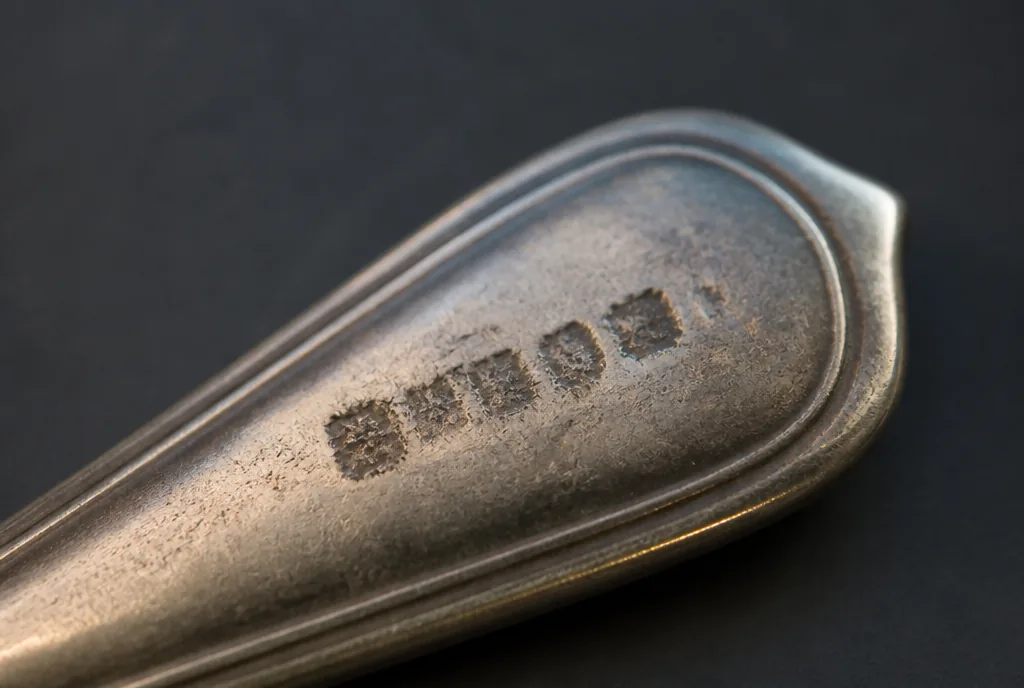
Quick answerA British hallmark has three compulsory parts: the sponsor’s (maker’s) mark, a fineness mark giving purity in parts per thousand, and the assay office mark. Older pieces may also carry a lion passant for sterling and a date letter, which was compulsory until 1999. To date a piece, identify the office first, then read the date letter by its style and shield shape, never by the letter alone.
This guide walks you through a row of British hallmarks one punch at a time, so you can tell who sent the piece for testing, what standard it meets, which office marked it and, often, roughly when. It can’t replace a date-letter table for the specific office; the same letter recurs across many cycles. It also can’t vouch for marks on plated wares, which often imitate hallmarks.
The three marks the law requires
Current UK guidance from GOV.UK names three compulsory parts. Each answers a different question.
- Sponsor’s mark. At least two letters inside a surround. It identifies the maker or the firm that sent the piece in, and no two sponsor’s marks at the same assay office are alike.
- Metal and fineness mark. Purity in parts per thousand, such as 925. The shape of the surround around the number shows which metal it is. This numeric format became compulsory in 1999.
- Assay office mark. The symbol of the office that tested and struck the piece.
The UK can hallmark silver at four finenesses: 800, 925, 958 and 999. A number outside that list inside a British-looking row is worth a second look.
Which office? Reading the town mark
Four assay offices operate today, according to the Goldsmiths’ Company Assay Office in London. Older silver can also carry historic town marks, which the Silver Society lists.
| Office | Mark | Status |
|---|---|---|
| London | Leopard’s head | Operating |
| Birmingham | Anchor | Operating |
| Sheffield | Rose (earlier a crown) | Operating |
| Edinburgh | Castle | Operating |
| Chester | Sword between wheatsheaves | Historic |
| Glasgow | Tree, fish, bird and bell | Historic |
| Dublin | Seated Hibernia | Historic |
London is a special case. The Silver Society notes that London pieces carried the leopard’s head and lion passant rather than a separate town mark.
Sheffield’s switch from crown to rose is a useful dating clue, but sources differ on the year. Sheffield Assay Office’s own history says it lost its crown mark for silver in 1973, when the Hallmarking Act passed. The reference site silvermakersmarks.co.uk dates the rose to 1975, when the Act took effect. A Sheffield piece with a crown is from before that change; which of those two years marks the edge, we can’t settle from our sources.
The traditional marks: lion, Britannia and the date letter
Sheffield Assay Office describes three further marks as optional traditional marks today. On pieces made before 1999, the date letter at least should be there, because it was compulsory.
Lion passant. This lion stands for sterling, 925. The Goldsmiths’ Company dates the lion passant guardant to 1544.
Britannia and the lion’s head erased. In 1697 a higher standard arrived, marked with a lion’s head erased and a seated figure of Britannia. This Britannia standard is 958. Wikipedia’s article on silver standards says it was compulsory from 1697 to 1720 and optional afterwards. So a Britannia mark alone doesn’t pin a piece to those years.
Date letter. The annual date letter goes back to 1478. It was compulsory until 1999 and has been optional since. Today it changes on 1 January each year.
A modern piece with no date letter can still be fully hallmarked. Since 1999 the date letter has been optional, so its absence on recent silver isn’t a warning sign.
Reading a date letter without getting it wrong
The letter alone never gives you a year. Each office ran its own cycles, so the same letter turns up again and again. The Silver Society explains that the style of the letter and the shape of the shield around it together identify the office and the year.
Older letters also span parts of two calendar years, because letters used to change mid-year. Sheffield is the documented example: up to 1974 its letter changed on the first Monday in July, and from 1975 on 1 January. Our sources don’t give the old change days for London or the other offices, so for those, read any date letter as covering part of two years.
The Hallmarking Act 1973 consolidated the law. For the first time, all offices used the same date letter and alphabet.
- Find the town mark and identify the office from the table above. On London silver, look for the leopard’s head with the lion passant.
- Look at the date letter’s shape: capital or lowercase, and the typeface.
- Look at the shield around it. Its outline is part of the identification, not decoration.
- Match all three (office, letter style and shield) against that office’s date-letter table.
- On older pieces, write the date as a span of two years unless you know that office’s letter changed on 1 January at the time.
Other marks you may see
The sovereign’s head. A small profile of the monarch is a duty mark. It shows that the tax on silver and gold was paid, and it appeared from 1784 until the tax was withdrawn in 1890. It isn’t a royal endorsement. On its own it places a piece inside those years.
No hallmark at all. Not every genuine British silver item has one. Silver items under 7.78 g are exempt from compulsory hallmarking in the UK. Pre-1950 items may also be sold as silver without a hallmark, if they’re shown to be of minimum fineness.
Sheffield plate and electroplate often carry marks that imitate hallmarks. A row of small pictures that looks British isn’t proof of silver. Match the town mark to a real office and the letter to that office’s table before you accept it.
A short history, for context
| Year | What changed |
|---|---|
| 1300 | Edward I requires the leopard’s head on silver |
| 1363 | Maker’s mark added |
| 1478 | Annual date letter added |
| 1544 | Lion passant guardant appears |
| 1697 | Britannia standard (958): lion’s head erased and seated Britannia |
| 1720 | Britannia standard stops being compulsory |
| 1784 | Sovereign’s head duty mark begins |
| 1890 | Duty withdrawn; the duty mark ends |
| 1973 | Hallmarking Act; one date letter and alphabet for all offices |
| 1973 or 1975 | Sheffield’s crown gives way to the rose (sources differ) |
| 1975 | Sheffield’s date letter now changes on 1 January |
| 1999 | Numeric fineness mark compulsory; date letter becomes optional |
Putting it together
Read every punch in the row, but decide the office before anything else. The office tells you which date-letter table to use, and the letter’s style and shield give you the year, or two years on older pieces. The sponsor’s mark then points you toward the maker.
Take the sponsor’s initials to the Mark Finder or browse the silver hub. If the marks look British but the piece may be plate, our guides to silverplate abbreviations and sterling, coin silver and silverplate will help you sort it.
Sources
- Hallmarking: practical guidance – summary – GOV.UK
- Hallmarking Guidance Notes (PDF) – GOV.UK / Office for Product Safety
- What is a Hallmark? – The Goldsmiths’ Company Assay Office, London
- UK Hallmarks – Sheffield Assay Office
- History of Hallmarking – The Goldsmiths’ Company Assay Office, London
- Silver standards – Wikipedia
- Identify Your Silver – The Silver Society
- Sheffield Date Letters – silvermakersmarks.co.uk
- A Detailed History of Sheffield Assay Office
Questions people ask
When did hallmarking start in Britain?
The Goldsmiths' Company dates it to 1300, when Edward I required the leopard's head on silver. The maker's mark followed in 1363 and the annual date letter in 1478.
What silver purities can be hallmarked in the UK today?
UK assay offices can hallmark silver at 800, 925, 958 and 999 parts per thousand. The number sits inside a surround whose shape shows the metal.
Is a piece of British silver with no hallmark necessarily plate?
No. Silver items under 7.78 g are exempt from compulsory hallmarking, and pre-1950 items may be sold as silver without a hallmark if shown to be of minimum fineness.
What did the Hallmarking Act 1973 change?
It consolidated hallmarking law, and for the first time all the assay offices used the same date letter and alphabet. Sources differ on whether Sheffield's crown gave way to the rose in 1973 or in 1975.
The Mark Index is a reference for identifying and dating marks. It isn’t an appraisal or a guarantee of authenticity. Reproductions and later reissues can carry old marks.