Nippon, Japan and Occupied Japan marks: what each one dates to
Four origin marks, four eras. How US customs law shaped the wording on Japanese export ceramics, and where the rules break down.
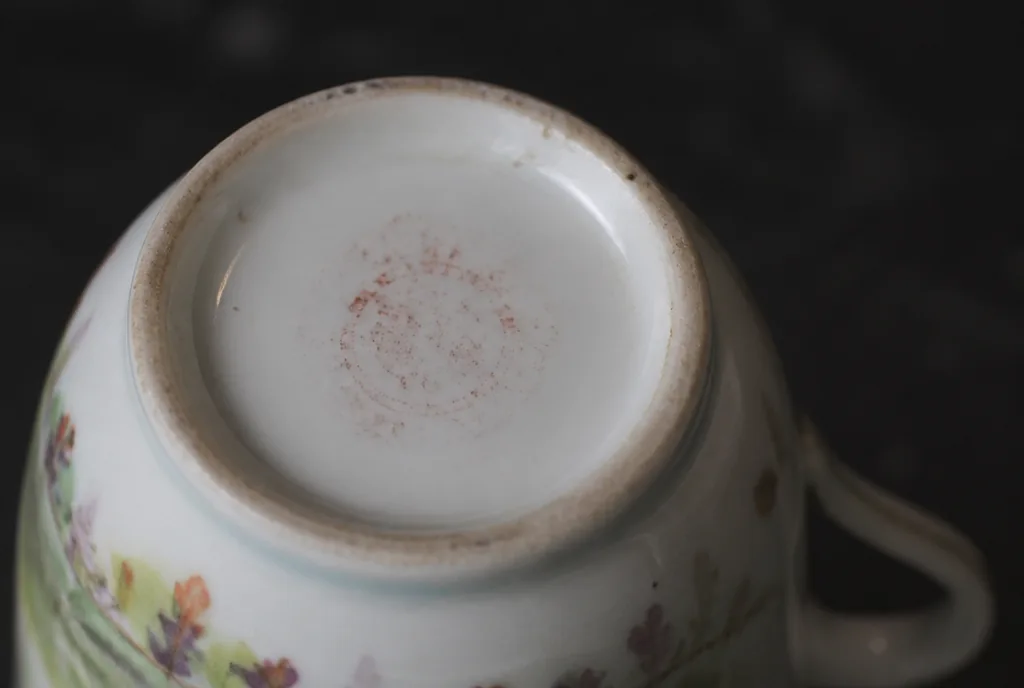
On pieces sold in the US, NIPPON generally means 1891 to 1921, and “Japan” or “Made in Japan” means after 1921. Those two later wordings were used side by side, so neither one is older. “Occupied Japan” or “Made in Occupied Japan” points to the postwar occupation, roughly 1947 to 1952, and after 1952 exports went back to “Made in Japan” or plain “Japan.”
These marks exist because of American customs law, not Japanese practice. That makes them a useful first dating clue for Japanese porcelain and pottery that came into the US. They give you an era, never a year, and they say nothing about who made the piece. Anything shipped to another country, or anything that lost its paper label, can break every rule below.
Why Japanese export wares carry an English country name
The McKinley Tariff Act of 1890 set the rule. From 1 March 1891, imported articles that were normally marked had to be “plainly marked, stamped, branded, or labeled in legible English words” with their country of origin, or they would be refused entry.
The law didn’t ban Japanese or Chinese characters. It required the country name in Western letters as well, which is why many pieces carry both. Japanese exporters first complied by marking wares NIPPON, the romanized Japanese name for Japan.
What each wording usually means
Use this table as a starting point, then read the section for your mark. The dates apply to wares exported to the US.
| Wording on the piece | What it usually means | Watch for |
|---|---|---|
| NIPPON | 1891 to 1921 (the Nippon Collectors Club’s dating of the Nippon era) | Fake Nippon backstamps are common |
| JAPAN | 1921 to 1941, and again after 1952 | Some imports used it during 1891 to 1921 as well |
| MADE IN JAPAN | 1921 to 1941, and again after 1952 | Not older or newer than plain “Japan” |
| OCCUPIED JAPAN or MADE IN OCCUPIED JAPAN | The occupation years; ordered from February 1947, and many firms kept using it until 1952 | Plain “Japan” was also allowed in these years |
| Japanese characters reading Nippon or Dai Nippon | Not a US customs mark at all; Dai Nippon marks are generally felt to be Meiji period (1868 to 1912) | Don’t apply the English NIPPON rule to these |
| No mark | Could be any era | Nippon-era pieces sometimes had only a paper label or marked packaging |
NIPPON: 1891 to 1921
The Nippon Collectors Club dates the Nippon era from 1891 to 1921. It ended when a 1921 US Treasury decision required “Japan” instead of “Nippon” as an acceptable origin mark. We couldn’t find the decision’s number or month in any source we opened, so treat 1921 as a boundary year rather than a precise day.
The rule has two known leaks. Some Japanese imports came in marked JAPAN even during 1891 to 1921. And some genuine Nippon-era pieces were never stamped at all; they carried paper labels or came in marked packaging, and those labels are often long gone.
Gotheborg.com makes the wider point plainly: NIPPON for 1891 to 1921 and “Japan” for after 1921 is a rule of thumb for the US market only. Pieces sent elsewhere don’t follow it.
Nippon written in Japanese characters
A mark in Japanese characters that reads Nippon, or Dai Nippon (“Great Japan”), has nothing to do with US customs rules. Dai Nippon marks are generally felt to be Meiji period, 1868 to 1912. Don’t date these by the English-word rule.
A NIPPON backstamp is not proof of age on its own. Fake Nippon backstamps are common. Our guide to reproductions and fake marks covers the known problem stamps.
JAPAN and MADE IN JAPAN: 1921 onward
From 1921 to 1941, Japanese wares exported to the US had to be marked “Japan” or “Made in Japan.” Both wordings ran in the same years. A common belief says one is older than the other, in either direction; the sources we use don’t support it.
Then there’s a real gap. Most Japanese ceramic factories stopped export production during World War II, so few exported wares date from those years. After 1952, exports were usually marked “Made in Japan” or just “Japan” again.
So these two wordings, by themselves, can’t separate a piece from the 1920s from one made in the 1950s or later. The maker’s own mark, if there is one, is the next thing to check.
OCCUPIED JAPAN: 1945 to 1952
The Allied occupation of Japan ran from 2 September 1945 to 28 April 1952, when the Treaty of San Francisco took effect. Sources differ slightly on the end: a Gotheborg Q&A gives April 25, 1952, while Wikipedia uses the treaty’s effective date of April 28.
The marking rules inside those years are less firmly documented. A WorthPoint dictionary entry says the occupation headquarters ordered exports marked “Occupied Japan” or “Made in Occupied Japan” in February 1947. It says a 1949 directive also allowed “Made in Japan” or “Japan,” and that the requirement was dropped in December 1949, though many firms kept using the Occupied Japan mark until 1952. We found those dates in a dictionary entry, not a government document, so read them as a reasonable outline.
Not every piece was marked. A collector quoted on Gotheborg says only part of the output had to carry the mark (one contributor puts it at half, which we couldn’t confirm). That’s how one shaker in a salt and pepper pair can say “Occupied Japan” while its partner says just “Japan.” The same collector notes the mark could be a paper or cloth label, or engraved, handwritten or stamped.
If a matched set has one piece marked “Occupied Japan” and one marked “Japan,” that isn’t a sign of a mismatch by itself. Plain “Japan” was permitted in the occupation years, and marking was only required on part of the output.
Before you date a piece by its origin mark
- Confirm the wording is in English letters. Japanese-character Nippon marks follow different logic.
- Remember that “Japan” and “Made in Japan” share the same years, both before the war and after 1952.
- An unmarked piece can still be Nippon-era, since paper labels wash off or fall away.
- Don’t assume every 1947 to 1952 export says “Occupied Japan.”
- Treat any NIPPON mark with suspicion until the piece itself (body, painting, gilding) agrees with it.
Putting it together
Read the origin wording first to get an era, then look for a maker’s mark alongside it. If there is one, try it in the Mark Finder or browse our pottery and porcelain entries. If there’s no mark at all, our guide to researching an unmarked piece is the better next step. And before you trust a NIPPON stamp, check it against the known fakes.
Sources
- Glossary: McKinley Tariff Act (1890) – Gotheborg.com
- What is the Nippon Era? – Nippon Collectors Club
- Glossary: Nippon porcelain 1891-1921 – Gotheborg.com
- Made in Japan or Japan – Modern Japanese Pottery and Porcelain Marks
- Occupation of Japan – Wikipedia
- Occupied Japan Ceramics – WorthPoint Dictionary
- Q&A: Occupied Japan – Gotheborg.com
Questions people ask
Is "Made in Japan" older than "Japan"?
No. From 1921 to 1941 both wordings were used on Japanese wares exported to the US, and after 1952 exports were again usually marked one way or the other. Neither wording dates earlier than the other.
Why does my Nippon-era piece also have Japanese characters?
The McKinley Tariff Act didn't ban Japanese or Chinese characters. It required the country name in legible English words as well, so a piece can carry both.
When exactly did the Occupied Japan period end?
Wikipedia dates the end of the occupation to 28 April 1952, when the Treaty of San Francisco took effect; a Gotheborg Q&A gives April 25. According to a WorthPoint dictionary entry, the marking requirement itself was dropped in December 1949, though many firms kept using the mark until 1952.
Do these rules apply to Japanese ceramics sold outside the US?
No. The NIPPON-then-Japan rule of thumb only holds for the US market. Pieces sent to other countries, or pieces that lost their paper labels, don't follow it.
The Mark Index is a reference for identifying and dating marks. It isn’t an appraisal or a guarantee of authenticity. Reproductions and later reissues can carry old marks.