Vintage costume jewelry identification: marks and unsigned pieces
Find the signature, read every mark on the piece, and date it from the clues. When there's no mark, here's what construction can and can't tell you.
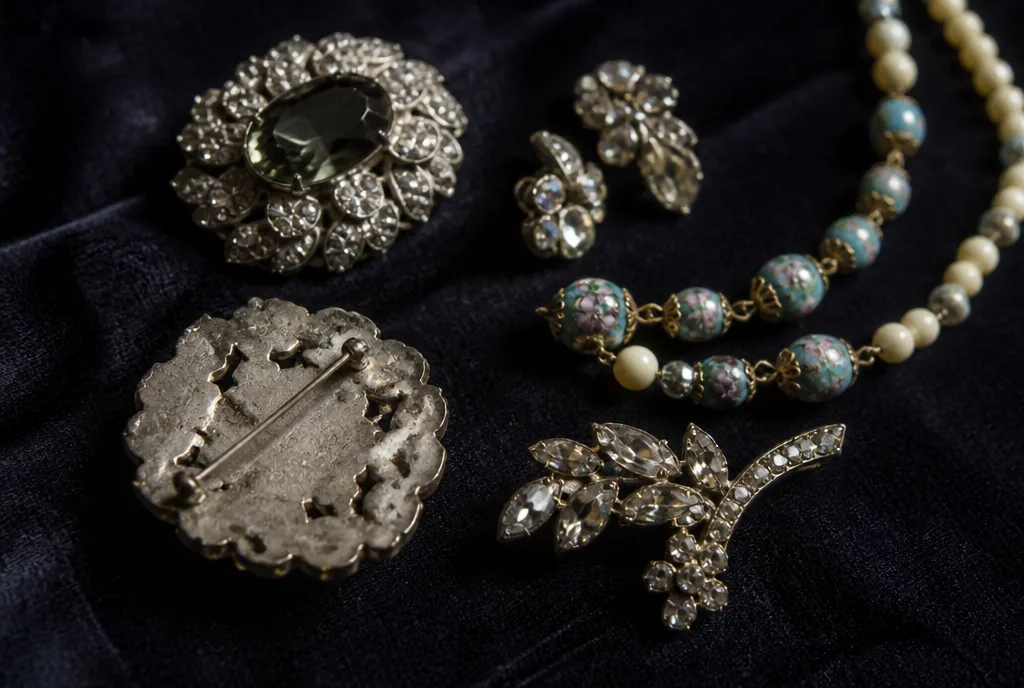
Quick answerTo identify vintage costume jewelry, find the signature first: check the clasp, the back of a brooch, any small plaque on a necklace or bracelet, and the clips of earrings. Copy the mark exactly. The maker’s name tells you who made it and gives a span of years, while extras such as a ©, a “Des.” or “Pat.” number, or the word Sterling narrow the date. If there’s no mark at all, construction can show what a piece is consistent with, but it can’t prove a maker.
This guide follows a piece in the order you’d handle it: where to look, how to read what you find, how marks date a piece, and what to do when there’s nothing to read. It doesn’t put a value on anything, and it can’t turn an unsigned brooch into a named one. For every maker’s marks with their years, our costume jewelry marks reference is the companion page. Here we stick to method.
- Look first
- Clasp, brooch back, plaque, earring clip
- A © in the mark
- Mostly mid-1950s or later
- Des. or D + number
- A design patent; look up its year
- No mark
- “Consistent with,” never proof
Where is the mark on vintage costume jewelry?
On a necklace or bracelet, start with the clasp. That isn’t just collector habit. In 1955, ruling in Trifari’s copyright case against Charel, a federal judge noted that the © notice on Trifari’s clasp sat “at the place where according to the custom and usage in the industry, the name of the maker of the article usually appears.” Wikipedia’s account of Sarah Coventry gives the same short list for that firm: the back of a brooch, the clasp, or a hang tag.
On a brooch, search the whole back rather than just the center. The Victoria and Albert Museum holds a 1950s run of Trifari brooch castings from Providence, one for each stage of production. On most of them the stamped crown-over-T mark sits on the reverse near the catch; on one it’s on an outer leaf.
- Plaques and cartouches. Some makers put the name on a small separate plate. Miriam Haskell’s oval cartouche is the best known. Napier’s mark could be stamped, embossed or carried on a plaque, depending on the design.
- Earring clips. DeMarc Treasures records DESIGN PAT PEND on the tops of Trifari earring clips, first seen on pairs made in 1952. Antique Trader notes that on some early Napier screw-backs only one earring is marked, so check both.
- Tags instead of metal. Antique Trader says Monet necklaces and bracelets made from 1937 to the mid-1940s came with “Monet Jewelers” metal hang tags. DeLizza & Elster’s Juliana line was identified only by a paper hang tag. Once a tag is gone, the piece reads as unmarked.
Use a loupe or your phone camera’s zoom with one light held low to the side, so stamped letters throw shadows. Write the mark down letter for letter, with every period, accent and symbol, before you search for it.
What do costume jewelry marks look like?
Most pieces carry more than one kind of mark. Treat each one as a separate clue: some tell you who, others only when.
Names the maker and gives a span. Here with a crown over the T.
A picture mark. Coro’s winged horse sits beside the name.
Copyright in the design.
The year the design was patented. Look it up.
An application was filed; no number to look up.
On a US piece, a claim of 925 silver.
Lettering style can matter as much as the words. Antique Trader describes early Monocraft lines marked MONOCRAFT in block letters, and early Monet brooches marked Monét in a serif face with an accent over the e; later pieces read MONET. Napier used its name in block letters from 1922, and Wikipedia says a script version followed in 1965. So “script or block?” is worth writing down along with the spelling.
How do you date costume jewelry from its marks?
Each clue on the back sets an earliest date. Take the latest of those floors and you have the best “not before” the marks can give. A maker’s closing date, where it’s known, sets the other end.
The © is the clue most people know. The 1955 opinion in Trifari v. Charel, dated September 28, held that costume jewelry could be copyrighted, and most makers moved from design patents to copyright afterward. “After 1955” is a soft line, though, because some © notices are earlier. Our guide to the copyright symbol on costume jewelry sets out the exceptions.
For a patent number, read the letters in front of it first. DES. or D means a design patent, a separate series that runs far lower than utility numbers. Design patents granted from 1937 through 1959 fall between D102,601, the first of 1937, and D186,973, the first of 1960. A plain number is a utility patent. DeMarc records a Trifari mark reading:
Utility patent 2,050,804 falls between the first numbers of 1936 (2,026,516) and 1937 (2,066,309), so it issued in 1936. Type any number into the patent number dater to get its year. The year tells you when the patent was granted, not when your piece was made; our guide to patent numbers and “Pat. Pend.” explains why.
STERLING on a costume piece often points to the World War II years. Base metals went to military production and were banned for private use, so makers turned to silver: DeMarc dates the TRIFARI STERLING mark to 1942 through 1947, and Antique Trader says rationing moved Eisenberg from pot metal to sterling. It isn’t a firm limit; see sterling on 1940s costume jewelry.
- Write down every mark on every part: back, clasp, plaque, clips, tag.
- Find the maker and the years its mark was used.
- Add the notice: a © means mostly mid-1950s or later.
- Convert any Des. or Pat. number to its year.
- Note STERLING or a country word.
- Take the latest floor, then check it against the maker’s closing date.
Which signatures point to which maker and date?
These are signature clues for makers we cover, each backed by two independent references or by the US Patent and Trademark Office’s own trademark records. A “claimed first use” is the date the company gave when it applied for the trademark. Each maker’s entry lists more marks.
| Signature | Maker | What it tells you |
|---|---|---|
| TRIFARI with a crown over the T | Trifari | Claimed first use December 20, 1937; still used in the 1950s and 1960s |
| TRIFARI with © | Trifari | Mid-1950s or later |
| Coro Craft beside a Pegasus | Coro | Claimed first use March 1938 |
| Coro beside a Pegasus | Coro | Claimed first use June 1945 |
| MONET | Monet | Claimed first use September 1, 1937 |
| Miriam Haskell, stamped or on a plaque | Miriam Haskell | Late 1940s or later; earlier Haskell was unmarked |
| NAPIER in block letters | Napier | 1922 or later; used into the 2000s |
| Kramer or Kramer of N.Y. | Kramer | 1943 to about 1980 |
| Any Weiss mark | Weiss | 1942 to 1971, when the firm closed |
| Eisenberg Original | Eisenberg | 1930s and 1940s |
The first-use dates in the Trifari and Coro rows come straight from the USPTO filings, and collector sites that repeat them are copying the same records. More makers, including Lisner, Sarah Coventry and Hobé, have their own entries.
How do you identify unsigned vintage costume jewelry?
Unsigned is normal. “Most early vintage costume jewelry is not ‘signed’ or marked with a maker’s mark,” as a Vintage Fashion Guild jewelry workshop puts it. A piece can be blank for at least four reasons:
- The maker didn’t mark it yet. Haskell jewelry had no permanent signature until the late 1940s. Antique Trader says a correctly marked piece dates after 1947; Wikipedia says the jewelry was seldom signed before 1950.
- The name was on a tag. Juliana pieces, early Haskell (Very Vintage describes a black and gold paper tag) and Monet’s tagged necklaces all lose their identity when the tag goes.
- Someone else made it. Sarah Coventry didn’t manufacture its own jewelry. Outside firms such as S&M Enameling of Providence and DeLizza & Elster made it, and D&E sold to other companies too, so look-alike pieces turn up without any Sarah Coventry mark.
- Only part of a set was marked, like the early Napier earrings above.
Without a mark, construction is the evidence. None of these clues names a maker by itself.
| What you see | What it can tell you | What it can’t |
|---|---|---|
| Stones glued in | Little on its own: even Trifari glued stones, and the V&A’s finished 1950s brooch comes with its original display label, “stones glued, baked” | That a piece is cheap or recent |
| Dull or darkened rhinestones | The foil behind them may have tarnished; tarnished foil can’t be cleaned, so the stone has to be replaced | Whether the other stones are original |
| Rainbow Aurora Borealis stones | Mid-1950s or later: Antique Trader says 1955, AnOther Magazine says 1956 | The date of a piece whose stones were replaced |
| Unplated silver-colored pot metal | One reference, Antique Trader, says it often points to the 1930s | A firm date |
| Beads hand-wired to a filigree back | Typical Miriam Haskell construction; filigree backs from the late 1940s on | Haskell, without a mark: cheaper firms copied the look |
Plating could be layered, too. The V&A’s Trifari series shows the cast metal plated with copper, then nickel, then rhodium, with gold added in places. Weight is harder to read. Very Vintage says genuine postwar Haskell filigree backs are weighty and fakes lighter, but weight only means something next to a documented, marked example.
Pin stems and catches, briefly
A finding only shows that a piece is no older than that finding. The plain C-shaped catch was standard on brooches until about 1900, when hinged safety catches began to be patented; the modern safety catch was in common use by the 1920s. A long pin stem with a C catch suggests an older piece, but C catches never disappeared, so one on its own proves little. Antique Trader adds that a trombone clasp on a brooch can point to European, possibly French, manufacture.
Write up an unsigned piece as “consistent with” a maker or period, and list the features you’re relying on. If two independent features don’t agree, keep the attribution open.
How do you spot married pieces and fake signatures?
A signed part only vouches for itself. In a Collectors Weekly interview, rhinestone jewelry repairer Rosalie Sayyah says replacing stones is the most requested repair, and that her shop changes clasps and puts clasps on bracelets, necklaces and pins. Some brooches have been turned into pendants by removing the pin and adding a loop. So a signed clasp on a necklace proves the clasp, and a signed brooch sold with unsigned earrings as a “set” proves only the brooch. Check that the clasp matches the rest of the piece in color, wear and style.
Signatures can travel as well. Antique Trader reports that a handful of leftover Haskell horseshoe plaques were attached to pieces in later decades, and Very Vintage points out that a hang tag can be added or removed. Old parts don’t make a piece old either. Sayyah’s rule: “if only the stones are old the piece is NOT vintage.”
Counterfeit marks exist for several names. Antique Jewelry Investor describes fake Weiss that looks right from the front but cheap from the back, often with a textured, antiqued or oxidized finish, where genuine vintage Weiss has a smooth rhodium-plated back. Weiss closed in 1971, which rules out any later design wearing its name as original Weiss. For Eisenberg, Antique Trader says fakes exist but are relatively few, and it advises extra care with colored-rhinestone pieces and rare figurals marked Eisenberg Original.
A crisp, complete signature is not proof. When the mark and the construction disagree, believe the construction. Our guide to reproductions and fake marks covers copied jewelry marks, including raised lettering where the original was stamped in.
Putting it together
Find every mark, copy it exactly, and look the maker up. In the Mark Finder, choose Costume Jewelry, then type the letters you can read, or filter by symbol (a crown, a wing, a monogram) or by shape (cartouche, script) if the mark is a picture; there’s also an A to Z list of makers. The maker’s entry gives the span of its marks. Add the © and any patent year, take the latest floor, and check it against the maker’s dates, using our costume jewelry marks page when a mark detail matters. If there’s no mark, work through the construction clues and record the result as “consistent with,” not as a name.
Sources
- Trifari, Krussman & Fishel, Inc. v. Charel Co., 134 F. Supp. 551 (S.D.N.Y. 1955) – Caselaw Access Project
- Brooch casting, Trifari, 1950s (O86843, with O86817, O86837, O86841) – Victoria and Albert Museum
- TRIFARI (crown design), serial 71532381, and TRIFARI, serial 71401626 – USPTO TSDR
- CORO CRAFT (Pegasus), serial 71489901, and CORO (Pegasus), serial 71489900 – USPTO TSDR
- MONET, serial 72109807 – USPTO TSDR
- Trifari Maker’s Marks and Trademarks – DeMarc Treasures
- Coro, Corocraft & Vendome Makers Marks and Trademarks – DeMarc Treasures
- Table of Issue Years and Patent Numbers – USPTO (Internet Archive copy, Jan. 2026)
- U.S. Patent Number Guide (Michael White, Queen’s University) – Patent and Trademark Resource Centers Association
- Patent pending – Wikipedia
- 15 U.S. Code 296 – Standard of fineness of silver articles – Cornell LII
- 16 CFR 23.5 – Misrepresentation as to silver content (FTC Jewelry Guides) – Cornell LII
- How to Identify Unmarked Costume Jewelry (Pamela Wiggins Siegel) – Antique Trader
- Miriam Haskell Jewelry (Pamela Wiggins Siegel) – Antique Trader
- Authenticating Miriam Haskell Jewellery – Very Vintage
- Miriam Haskell – Wikipedia
- Monet Jewelers Rediscovered (Pamela Wiggins Siegel) – Antique Trader
- Discovering Napier Jewelry of the 1920s (Pamela Wiggins Siegel) – Antique Trader
- Napier Company (jewellery) – Wikipedia
- Napier Co. – Lang Antiques, Antique Jewelry University
- Discover Coro Costume Jewelry (Pamela Wiggins Siegel) – Antique Trader
- The Diamond Look by Kramer (Pamela Wiggins Siegel) – Antique Trader
- Kramer of New York – Wikipedia
- Vintage Weiss Jewelry – Collectors Weekly
- A Weiss Deception – Antique Jewelry Investor
- Identifying Costume Jewelry by Designer – Antique Jewelry Investor
- Collecting Eisenberg Jewelry Basics (Pamela Wiggins Siegel) – Antique Trader
- Sarah Coventry – Wikipedia
- Vintage Sarah Coventry Jewelry – Collectors Weekly
- Costume jewelry – Wikipedia
- Vintage Jewelry Workshop, Part I (Linn, 2010) – Vintage Fashion Guild Forums
- To Restore or Not to Restore? A Look at Vintage Rhinestone Jewelry (interview with Rosalie Sayyah) – Collectors Weekly
- Gemstone Surface Enhancements – Lang Antiques, Antique Jewelry University
- Swarovski: The Crystalline Looks That Made Fashion History (Olivia Singer) – AnOther Magazine
- Rhinestones – Everything About Vintage Costume Jewelry (wiki)
- C Pin Catch – Lang Antiques, Antique Jewelry University
- Dating Brooches by Type of Clasp or Fastening – Modern Vintage Style
- Converted or Re-purposed Antique Jewellery: Part I – navettejewellery.org
Questions people ask
Where are the maker's marks on costume jewelry?
Check the clasp of a necklace or bracelet first: in the 1955 Trifari copyright case the court called the clasp the usual place for the maker's name. On brooches, look over the whole back, since the V&A's 1950s Trifari brooches are stamped near the catch, and on earrings check the clips and both earrings of the pair. Some makers used a small plaque or only a hang tag.
How can I identify unsigned vintage costume jewelry?
Look at how it was made: the stones, the plating, the backing and the pin and catch. Each feature can rule periods in or out, for example rainbow Aurora Borealis stones date from the mid-1950s on, but none names a maker on its own. Compare the piece with documented marked examples and describe the result as consistent with a maker or period.
Can I look up costume jewelry marks by symbol or in alphabetical order?
Yes. The Mark Index Mark Finder lets you pick Costume Jewelry and filter by a symbol such as a crown or a wing, or by shape such as a cartouche or script, and it links an A to Z list of makers. A crown over the T of TRIFARI points to Trifari, and a winged horse beside the name points to Coro.
What does DES. PAT. or a D number mean on jewelry?
It marks a US design patent, which protected the look of the piece. Design patents have their own number series, much lower than utility patents of the same years: those granted from 1937 through 1959 run from D102,601 up to the first of 1960, D186,973. Look the number up to get the year the patent was granted; that dates the design, not the day your piece was made.
Does a signature prove a piece is genuine vintage?
No. Clasps get replaced, plaques and hang tags can be added to other pieces, and counterfeit marks exist for names such as Weiss. Check that the construction and finish on the back match the maker's documented work, and trust the construction if the two disagree.
The Mark Index is a reference for identifying and dating marks. It isn’t an appraisal or a guarantee of authenticity. Reproductions and later reissues can carry old marks.