How to research an unmarked piece
An order of work for pottery, jewelry and silver with no mark, and why the honest answer is usually "consistent with" rather than "made by."
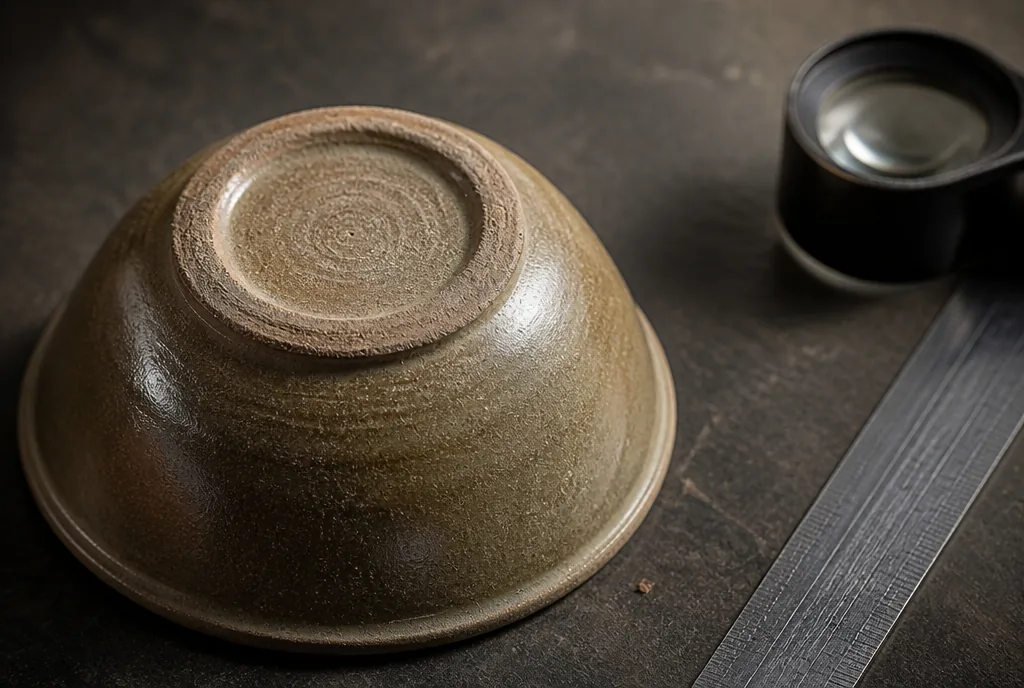
Quick answerHere’s how to identify unmarked pottery, jewelry or silver: start by working out what the piece is made of, then look at how it was decorated or built, then compare its body, glaze, weight and construction with documented, marked examples. Many genuine pieces were never marked, or lost a paper label long ago. Without a mark, the best honest result is “consistent with” a maker or period, not proof.
This guide gives you an order of work for pottery, porcelain, stoneware, costume jewelry and silver that carries no mark. It can help you narrow a piece down and rule things out. It can’t turn a likely attribution into a certain one, and none of our sources offers a formal method that does.
Why so many pieces have no mark
An unmarked piece isn’t automatically modern, and it isn’t automatically a fake. Many genuine pieces left the maker without one, and others lost theirs.
Early English pottery was often unmarked because it was made for merchants and wholesalers, not for the people who would eventually use it. Decoration mattered more than who made it, and copying was common. In Minnesota, only about 20% of Red Wing’s salt-glaze stoneware was marked.
Some marks were never permanent. The absence of a “Nippon” mark doesn’t rule out the Nippon period, because paper labels were used and many have been lost. And many 20th-century wares carry only a painted pattern number, whose details live in the factory’s pattern books rather than on the piece.
Step one: pin down the material
Before you think about makers, decide what kind of object you have. With ceramics, the first split is stoneware versus porcelain.
Stoneware is vitrified, fired to roughly 1100 to 1200 C, and it isn’t translucent. Porcelain can be. Hold a thin edge or rim up to a strong light: if light shows through, you’re not looking at stoneware.
For silver, material is the whole question. In the UK, unhallmarked items made before 1950 can be sold as precious metal only if the seller can show both minimum fineness and pre-1950 manufacture. In practice, that means unmarked silver needs testing, not a guess.
Acid and scratch tests on silver can damage the piece. If you’re not sure how to do them safely, or whether the piece can take it, leave testing to someone who does it regularly.
Step two: read the decoration
Decide whether the decoration was painted by hand or printed. It changes which makers and periods are even possible.
Hand painting shows brush strokes, small color variation and uneven pigment. Printed work is uniform, repeats exactly and may show broken lines. Look at a repeated motif, such as a border, and compare one section with the next.
The same test works on stoneware. Stamped decoration on crocks is neater and repeats exactly, while hand-drawn cobalt doesn’t.
Step three: compare body, glaze and weight
Once a pottery firm has closed, telling a real piece from a reproduction depends on physical attributes: the clay body, the glaze and the weight. That’s the core of attribution without a mark.
Nippon porcelain is a good example of how specific these clues get. The Nippon Collectors Club describes genuine Nippon-era porcelain as thin, light and translucent with lustrous gold, while fakes are often heavier with brassy gilding.
For unmarked salt-glaze stoneware, Red Wing collectors go on form, decoration, and clay and glaze color. Our guide to stoneware crock marks covers what those look like on Red Wing pieces.
One caution: weight and “feel” only mean something next to a documented example. On their own, they prove nothing about age.
Unmarked costume jewelry
Jewelry can sometimes be attributed by how it was built. Schreiner brooches are one documented case: collectors look for hook-and-eye backs and inverted, unfoiled stones. No single feature proves an attribution, though, so look for several that agree.
Clasps and findings help with date even when they can’t name a maker.
| Clasp or finding | What it suggests |
|---|---|
| Spring ring clasp | Before the 1950s |
| Box clasp | Before the 1950s |
| Fold-over clasp | Before the 1950s |
| Hook-and-extender necklace clasp | The 1950s on |
Read the clasp as one clue among several, alongside construction and materials.
Checklist before you name a maker
- Have you confirmed the material (stoneware, porcelain, metal)?
- Have you decided whether the decoration is hand-painted or printed?
- Have you compared the body, glaze and weight against marked, documented examples of that maker?
- Do at least two independent features point the same way?
- Have you checked for a lost label, a pattern number or a mark on a matching piece?
- Would you still make the attribution if the most famous maker’s name weren’t on your mind?
A common mistake is attributing an unmarked piece to a famous maker on the strength of one feature. Several sources stress that without marks, attribution is probability, not proof. Write it up as “consistent with” a maker, and say which features you’re relying on.
Where to turn for comparison
For British silver, the standard references for marks include Bradbury’s Book of Hallmarks and Jackson’s Silver & Gold Marks. If a piece turns out to carry a worn or partial mark after all, those books are where to check it. Our guide to British silver hallmarks explains the parts of a full mark.
For Nippon-era porcelain, see Nippon, Japan, Made in Japan and Occupied Japan for what the marks date to, which helps when a matching marked piece turns up.
Putting it together
- Confirm the material.
- Decide hand-painted or printed, hand-drawn or stamped.
- Compare body, glaze, weight and construction with documented marked examples.
- Check clasps and findings on jewelry; have unmarked silver tested properly.
- Record your result as “consistent with,” listing the features that support it.
If a mark does turn up, even a partial one, take it to the Mark Finder.
Sources
- English Pottery Marks – A General Guide to Identification and Dating – thepotteries.org (Steve Birks)
- Identify: fakes and misleading branding – thepotteries.org
- Salt Glaze – Red Wing Collectors Society
- Glossary: Nippon porcelain 1891-1921 – Gotheborg.com
- Glossary: Printed or hand-painted decorations – Gotheborg.com
- Reproductions Alerts – Nippon Collectors Club
- Glossary: Stoneware – Gotheborg.com (Jan-Erik Nilsson)
- Identifying Unmarked Costume Jewelry: Schreiner Brooches – Costume Jewelry Collectors Int’l
- Vintage Costume Jewelry Tools for Dating – Costume Jewelry Collectors Int’l
- Hallmarking Guidance Notes (PDF) – GOV.UK / Office for Product Safety
- Identify Your Silver – The Silver Society
Questions people ask
Does an unmarked piece mean it's a reproduction?
No. Early English pottery was often made for merchants and wholesalers and left unmarked, and only about 20% of Red Wing's salt-glaze stoneware carried a mark. Paper labels on Nippon-era pieces have often been lost.
How can I tell genuine Nippon porcelain without a mark?
The Nippon Collectors Club describes genuine Nippon-era porcelain as thin, light and translucent, with lustrous gold. Fakes are often heavier and have brassy gilding.
Can I sell unmarked silver as silver in the UK?
UK hallmarking guidance says unhallmarked items made before 1950 can be sold as precious metal only if the seller can show minimum fineness and pre-1950 manufacture. That means having the piece tested.
What books cover British silver marks?
The Silver Society names Bradbury's Book of Hallmarks and Jackson's Silver & Gold Marks among the standard references.
The Mark Index is a reference for identifying and dating marks. It isn’t an appraisal or a guarantee of authenticity. Reproductions and later reissues can carry old marks.