Where to look for marks on pottery, crocks, jewelry and silver
Where to look first on plates, figurines, crocks, jewelry and silver, and what a bare base can and can't tell you.
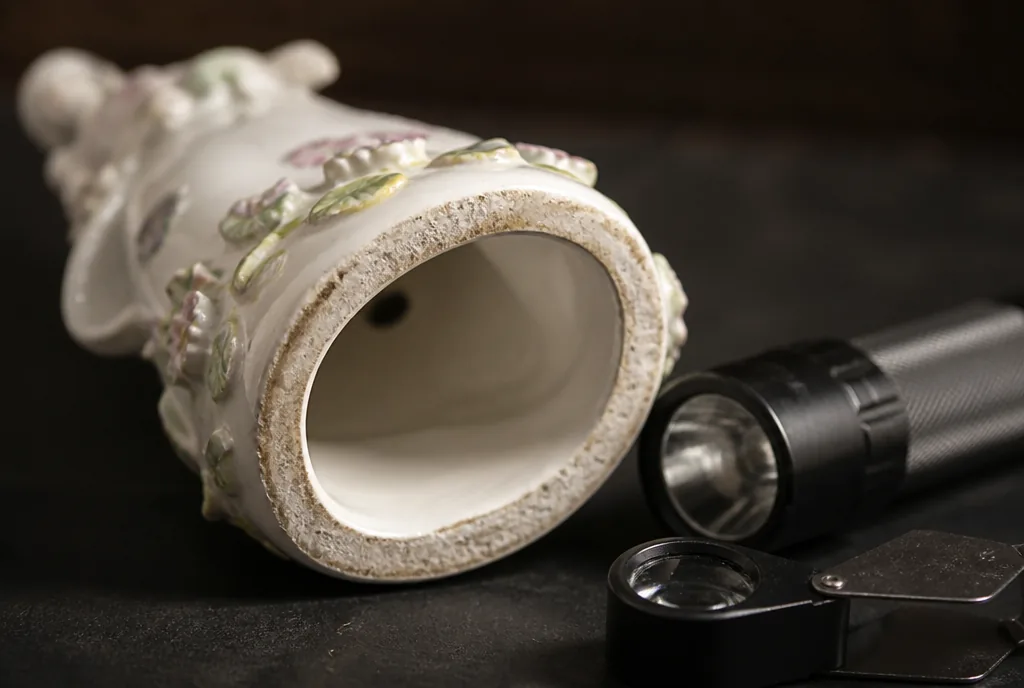
Quick answerOn pottery and porcelain, turn the piece over: marks are usually on the underside. Stoneware crocks are the exception, with the maker’s mark often near the top of the side wall and the size number on the front. On jewelry, check the back for a small signature plate. On silver, look for the maker’s mark and the quality mark sitting together as a group.
This guide tells you where to look first on each kind of object, and why a mark might not be there at all. It won’t identify the mark for you. Once you’ve found it, the Mark Finder and the maker entries take over.
A word on limits. Our sources are clear about pottery, crocks and silver marks. They say much less about the exact spot on a fork handle or a necklace, and we say so below instead of guessing.
Plates, cups and figurines
Start with the base. Pottery and porcelain marks are usually on the underside of the piece. That’s true for a dinner plate, a teacup and a porcelain figurine alike, since all of them are pottery or porcelain.
What you find there varies a lot. Staffordshire makers identified their wares with letters, initials, company names, symbols or crests, and registration numbers, all on the bottom. Western porcelain with printed decoration is usually marked underneath with Western lettering.
Some marks are printed in color and easy to see. Others are pressed into the clay and nearly vanish under the glaze. Tilt the base under a low, raking light, from a window or a phone flashlight held to one side, and the shadows will pick out impressed letters.
We don’t have a source that covers hidden marks inside the hollow base of a figurine, so we won’t tell you they’re there. Check the whole underside, inside and out, and don’t read anything into a blank one yet.
Stoneware crocks and jugs
Crocks break the “look underneath” rule. The maker’s mark usually sits near the top of the side wall or on the bottom. The capacity number, the big numeral that says how many gallons the crock holds, is on the front.
On Red Wing crocks, the capacity numeral and the decoration were stamped or drawn on the side, and the company’s birch-leaf or red-wing stamp was placed alongside them. So on those pieces, the maker’s stamp is right there with the size. Our guide to stoneware crock marks explains how to read each of those.
Costume jewelry
Turn the piece over. On genuine vintage designer earrings, Chanel for example, the mark is typically on a small signature plate or cartouche attached to the back. Fakes may lack the plate or show the mark only on the front.
Don’t stop at the base of a brooch, either. Jewelry marks can hide on clasps, cartouches and back plates, so look over every part of the piece, including the fittings.
Our sources don’t give a general rule for where marks sit on necklaces or bracelets. Check the clasp and anything that hangs near it, but treat that as a place to look rather than a rule.
Silver and flatware
On silver, marks travel in groups. Find one and the others are usually close by.
In the US, federal law requires the maker’s trademark to be applied close to the quality mark, in lettering at least as large. If you spot one, the other should be next to it.
UK hallmarks appear as a group too: a sponsor’s mark, a fineness mark and an assay office mark, sometimes with the optional lion, a date letter or a commemorative mark. See how to read British silver hallmarks for what each part means.
We have no source that pins down where on a spoon or fork the marks go. Look along the whole back of the piece, handle included, for the group.
A mark can outlive the object it was made for. UK hallmarking guidance notes that cutlery is often turned into pendants, rings and bracelets with the original mark still on it. A hallmark on a bracelet may be telling you about a spoon.
Where to look first: a quick checklist
| Object | Look here first | Then check |
|---|---|---|
| Plate, cup, bowl | The underside | Tilt under raking light for impressed marks |
| Porcelain figurine | The underside | Any label residue; the matching piece if it’s one of a pair |
| Stoneware crock | Near the top of the side wall | The bottom; the front for the gallon number |
| Earrings | A signature plate or cartouche on the back | Whether the mark shows only on the front (a warning sign) |
| Brooch, necklace | The back | Clasps, cartouches and back plates |
| US silver | The quality mark | The maker’s trademark right beside it |
| UK silver | The hallmark group | Date letter, lion or commemorative mark in the same row |
When there’s no mark where it should be
A bare base doesn’t always mean an unmarked maker. Some Nippon-era and Occupied Japan items were marked only with paper or cloth labels, and those are often lost. In a matched pair, only one piece may carry the origin mark, so check its partner before you decide.
Before you write a piece off as unmarked, look for any trace of a lost label. Then check the matching piece, if there is one.
If you still find nothing, how to research an unmarked piece covers what to look at instead.
Putting it together
Turn pottery over, check crocks high on the side, look at the back of jewelry and read silver marks as a group. Use a raking light for anything faint. When you’ve found a name, a symbol or a set of letters, take it to the Mark Finder.
Sources
- English Pottery Marks – A General Guide to Identification and Dating – thepotteries.org (Steve Birks)
- Staffordshire Pottery Marks: Identification Guide – thepotteries.org
- Glossary: Printed or hand-painted decorations – Gotheborg.com
- Rare Antique Stoneware Crocks – Know Old Stuff
- Zinc Glaze – Red Wing Collectors Society
- Q&A: Occupied Japan – Gotheborg.com
- Are My Flea Market Find Chanel Earrings Real or Fake? – Costume Jewelry Collectors Int’l
- 15 U.S. Code 297 – Stamping plated articles; trademark requirement – Cornell LII
- Hallmarking Guidance Notes (PDF) – GOV.UK / Office for Product Safety
Questions people ask
Why does only one of my pair of figurines have a mark?
Gotheborg notes that in a matched pair of Nippon-era or Occupied Japan items, only one piece may carry the origin mark. Some items were marked only with paper or cloth labels, which are often lost.
What marks should I expect to see on British silver?
UK hallmarks come as a group: a sponsor's mark, a fineness mark and an assay office mark. Some pieces also carry the optional lion, a date letter or a commemorative mark.
What kinds of marks did Staffordshire potters use?
Staffordshire makers used letters, initials, company names, symbols or crests, and registration numbers. They put them on the bottom of the ware.
Is a mark only on the front of an earring a problem?
It can be a warning sign. On genuine vintage designer earrings such as Chanel, the mark is typically on a signature plate or cartouche on the back, and fakes may lack the plate or show marks only on the front.
The Mark Index is a reference for identifying and dating marks. It isn’t an appraisal or a guarantee of authenticity. Reproductions and later reissues can carry old marks.